GUTSCHEIN
Bitte haben Sie einen Moment Geduld, wir legen Ihr Produkt in den Warenkorb.
Diese Produkte könnten Sie auch interessieren:
Bitte haben Sie einen Moment Geduld, wir legen Ihr Produkt in den Warenkorb.
| Reihe | Academic Press |
|---|---|
| ISBN | 9780128230145 |
| Sprache | Englisch |
| Erscheinungsdatum | 23.11.2020 |
| Größe | 235 x 191 mm |
| Verlag | Elsevier Inc |
| Herausgegeben von | Raghvendra Kumar, Brojo Kishore Mishra, Valentina Emilia Balas |
| Lieferzeit | Lieferung in 7-14 Werktagen |
| Herstellerangaben | Anzeigen Libri GmbH Europaallee 1 | D-36244 Bad Hersfeld gpsr@libri.de |
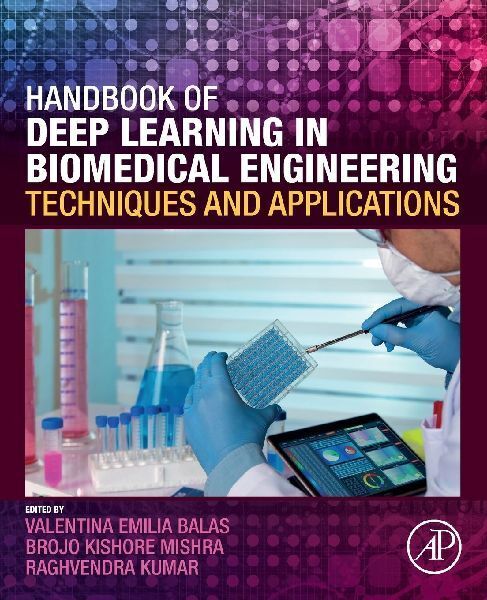
Deep Learning (DL) is a method of machine learning, running over Artificial Neural Networks, that uses multiple layers to extract high-level features from large amounts of raw data. Deep Learning methods apply levels of learning to transform input data into more abstract and composite information. Handbook for Deep Learning in Biomedical Engineering: Techniques and Applications gives readers a complete overview of the essential concepts of Deep Learning and its applications in the field of Biomedical Engineering. Deep learning has been rapidly developed in recent years, in terms of both methodological constructs and practical applications. Deep Learning provides computational models of multiple processing layers to learn and represent data with higher levels of abstraction. It is able to implicitly capture intricate structures of large-scale data and is ideally suited to many of the hardware architectures that are currently available. The ever-expanding amount of data that can be gathered through biomedical and clinical information sensing devices necessitates the development of machine learning and AI techniques such as Deep Learning and Convolutional Neural Networks to process and evaluate the data. Some examples of biomedical and clinical sensing devices that use Deep Learning include: Computed Tomography (CT), Magnetic Resonance Imaging (MRI), Ultrasound, Single Photon Emission Computed Tomography (SPECT), Positron Emission Tomography (PET), Magnetic Particle Imaging, EE/MEG, Optical Microscopy and Tomography, Photoacoustic Tomography, Electron Tomography, and Atomic Force Microscopy. Handbook for Deep Learning in Biomedical Engineering: Techniques and Applications provides the most complete coverage of Deep Learning applications in biomedical engineering available, including detailed real-world applications in areas such as computational neuroscience, neuroimaging, data fusion, medical image processing, neurological disorder diagnosis for diseases such as Alzheimer's, ADHD, and ASD, tumor prediction, as well as translational multimodal imaging analysis.
| Reihe | Academic Press |
|---|---|
| ISBN | 9780128230145 |
| Sprache | Englisch |
| Erscheinungsdatum | 23.11.2020 |
| Größe | 235 x 191 mm |
| Verlag | Elsevier Inc |
| Herausgegeben von | Raghvendra Kumar, Brojo Kishore Mishra, Valentina Emilia Balas |
| Lieferzeit | Lieferung in 7-14 Werktagen |
| Herstellerangaben | Anzeigen Libri GmbH Europaallee 1 | D-36244 Bad Hersfeld gpsr@libri.de |
Wie gefällt Ihnen unser Shop?