GUTSCHEIN
Bitte haben Sie einen Moment Geduld, wir legen Ihr Produkt in den Warenkorb.
Diese Produkte könnten Sie auch interessieren:
Bitte haben Sie einen Moment Geduld, wir legen Ihr Produkt in den Warenkorb.
| Themen | Wirtschaftswissenschaft, Finanzen, Betriebswirtschaft und Management Wirtschaftswissenschaft Ökonometrie und Wirtschaftsstatistik |
|---|---|
| ISBN | 9780262516884 |
| Sprache | Englisch |
| Erscheinungsdatum | 16.12.2011 |
| Größe | 229 x 152 mm |
| Verlag | MIT Press |
| Lieferzeit | Lieferung in 7-14 Werktagen |
| Herstellerangaben | Anzeigen Libri GmbH Europaallee 1 | D-36244 Bad Hersfeld gpsr@libri.de |
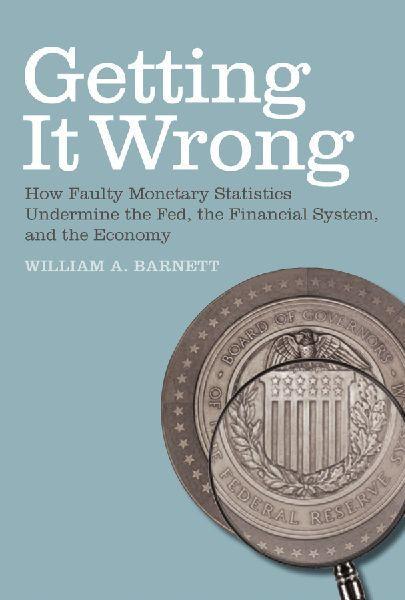
A leading economist contends that the recent financial crisis was caused not by the failure of mainstream economics but by corrupted monetary data constructed without reference to economics.Blame for the recent financial crisis and subsequent recession has commonly been assigned to everyone from Wall Street firms to individual homeowners. It has been widely argued that the crisis and recession were caused by “greed” and the failure of mainstream economics. In Getting It Wrong, leading economist William Barnett argues instead that there was too little use of the relevant economics, especially from the literature on economic measurement. Barnett contends that as financial instruments became more complex, the simple-sum monetary aggregation formulas used by central banks, including the U.S. Federal Reserve, became obsolete. Instead, a major increase in public availability of best-practice data was needed. Households, firms, and governments, lacking the requisite information, incorrectly assessed systemic risk and significantly increased their leverage and risk-taking activities. Better financial data, Barnett argues, could have signaled the misperceptions and prevented the erroneous systemic-risk assessments.When extensive, best-practice information is not available from the central bank, increased regulation can constrain the adverse consequences of ill-informed decisions. Instead, there was deregulation. The result, Barnett argues, was a worst-case toxic mix: increasing complexity of financial instruments, inadequate and poor-quality data, and declining regulation.Following his accessible narrative of the deep causes of the crisis and the long history of private and public errors, Barnett provides technical appendixes, containing the mathematical analysis supporting his arguments.
| Themen | Wirtschaftswissenschaft, Finanzen, Betriebswirtschaft und Management Wirtschaftswissenschaft Ökonometrie und Wirtschaftsstatistik |
|---|---|
| ISBN | 9780262516884 |
| Sprache | Englisch |
| Erscheinungsdatum | 16.12.2011 |
| Größe | 229 x 152 mm |
| Verlag | MIT Press |
| Lieferzeit | Lieferung in 7-14 Werktagen |
| Herstellerangaben | Anzeigen Libri GmbH Europaallee 1 | D-36244 Bad Hersfeld gpsr@libri.de |
Wie gefällt Ihnen unser Shop?