GUTSCHEIN
Bitte haben Sie einen Moment Geduld, wir legen Ihr Produkt in den Warenkorb.
Diese Produkte könnten Sie auch interessieren:
Auch verfügbar als:
Bitte haben Sie einen Moment Geduld, wir legen Ihr Produkt in den Warenkorb.
| Reihe | Advances in Experimental Medicine and Biology |
|---|---|
| Themen | Medizin Klinische und Innere Medizin Krankheiten und Störungen Onkologie |
| ISBN | 9780387097886 |
| Sprache | Englisch |
| Erscheinungsdatum | 27.10.2008 |
| Größe | 257 x 170 mm |
| Verlag | Springer |
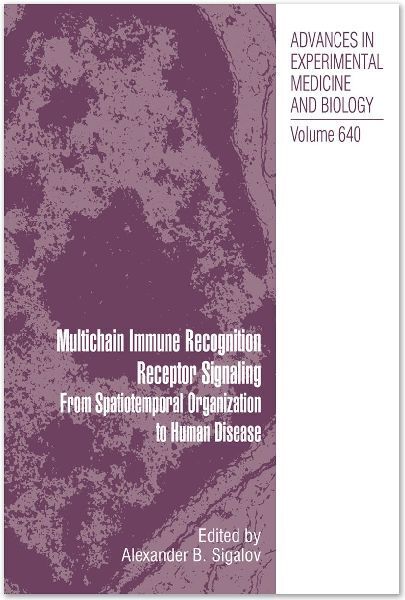
| Herausgegeben von | Alexander Sigalov |
| Lieferzeit | Lieferung in 7-14 Werktagen |
| Herstellerangaben | Anzeigen Europaplatz 3 | DE-69115 Heidelberg ProductSafety@springernature.com |
Immunological recognition is a central feature of the adaptive immunity of vertebrates. With the exception of agnathans, which developed an entirely distinct set of immunologically-specific molecules, all vertebrates use a recognition system based on what Achsah Keegan and I suggested in 1992 be termed multichain immune recognition receptors (MIRRs). MIRRs consist of ligand-binding molecules that are immunoglobulin supergene family members associated with signal transducers and enhancers in such a way as both insure precise ligand recognition, discrimination and ampHfication of the signal. Two of the prototypic sets of MIRRs, the T-cell and B-cell receptors, are among the most remarkable recognition molecules known. These are extraordinarily diverse molecules in which the range of ligands that can be potentially recognized prob ably exceeds the actual numbers of lymphocytes in the body. The discovery of the genetic basis of assembling these receptors and understanding how they bind to their cognate antigens are among the most stunning of scientific achievements. Yet these immensely specific binding chains (the heavy/light chain pair for immunoglobulin and the a/p chain pair for most T cells), when expressed as membrane molecules, have no obvious mechanism of signaling. For example, the |iH chain cytosolic do main consists of three amino acids (lysine-valine-lysine) and the L chain is not even embedded in the membrane. Furthermore, there is no known direct mechanism to propagate information from the binding domain of the B-cell or T-cell receptors to the membrane-proximal domains of the same chains.
| Reihe | Advances in Experimental Medicine and Biology |
|---|---|
| Themen | Medizin Klinische und Innere Medizin Krankheiten und Störungen Onkologie |
| ISBN | 9780387097886 |
| Sprache | Englisch |
| Erscheinungsdatum | 27.10.2008 |
| Größe | 257 x 170 mm |
| Verlag | Springer |
| Herausgegeben von | Alexander Sigalov |
| Lieferzeit | Lieferung in 7-14 Werktagen |
| Herstellerangaben | Anzeigen Europaplatz 3 | DE-69115 Heidelberg ProductSafety@springernature.com |
Wie gefällt Ihnen unser Shop?