GUTSCHEIN
Bitte haben Sie einen Moment Geduld, wir legen Ihr Produkt in den Warenkorb.
Diese Produkte könnten Sie auch interessieren:
Bitte haben Sie einen Moment Geduld, wir legen Ihr Produkt in den Warenkorb.
| Reihe | University of California Press |
|---|---|
| ISBN | 9780520330405 |
| Sprache | Englisch |
| Erscheinungsdatum | 27.08.2021 |
| Größe | 147 x 210 mm |
| Verlag | UCAL POD |
| Übersetzung | Anthony Preus |
| Lieferzeit | Lieferung in 7-14 Werktagen |
| Herstellerangaben | Anzeigen Libri GmbH Europaallee 1 | D-36244 Bad Hersfeld gpsr@libri.de |
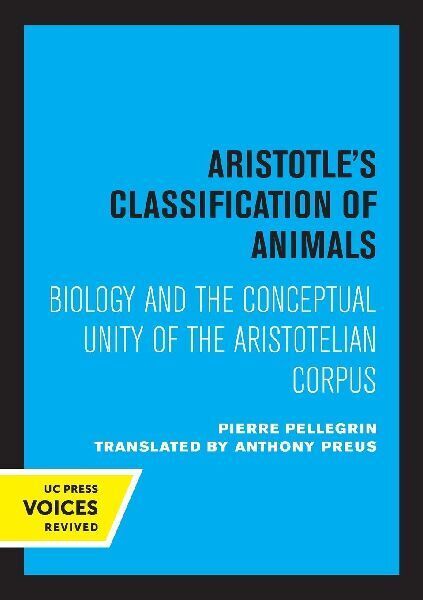
Aristotle's classification of animals, and indeed his approach to biology, challenges modern assumptions about scientific progress. Historians often view Aristotle's attempts at classification as incomplete precursors to the rigorous taxonomies of later scientists, such as Linnaeus, but this perspective may impose a retrospective, evolution-based understanding of science onto Aristotle's distinct worldview. While it's clear that Aristotle categorized animals based on their parts, characteristics, and behaviors, his classifications were not necessarily intended to function as comprehensive taxonomies. Instead, Aristotle's groupings reflect his philosophical quest to understand the essence of living things and the order of nature rather than a systematic effort to codify all species in a rigid structure. In his approach, classification served to illustrate larger principles and relationships rather than to build a finalized biological hierarchy.
Moreover, Aristotle's classificatory efforts differ fundamentally from later biological taxonomies in their conceptual basis and purpose. Modern commentators, including Georges Cuvier, acknowledge Aristotle's influence on fields like comparative anatomy but note that Aristotle did not apply a structured taxonomic system as his successors did. Instead, Aristotle's categories were flexible, reflecting his ideas on the "essence" and "form" of living beings rather than any fixed biological grid. This distinction becomes crucial when interpreting Aristotle's work: rather than regarding it as an incomplete taxonomy, we might view it as a philosophical framework that integrates observations with conceptual exploration of life's diversity and order. This approach, which seeks to understand each organism within a broader natural order, is less about classifying individual species and more about investigating the fundamental nature of life. This title is part of UC Press's Voices Revived program, which commemorates University of California Press's mission to seek out and cultivate the brightest minds and give them voice, reach, and impact. Drawing on a backlist dating to 1893, Voices Revived makes high-quality, peer-reviewed scholarship accessible once again using print-on-demand technology. This title was originally published in 1986.| Reihe | University of California Press |
|---|---|
| ISBN | 9780520330405 |
| Sprache | Englisch |
| Erscheinungsdatum | 27.08.2021 |
| Größe | 147 x 210 mm |
| Verlag | UCAL POD |
| Übersetzung | Anthony Preus |
| Lieferzeit | Lieferung in 7-14 Werktagen |
| Herstellerangaben | Anzeigen Libri GmbH Europaallee 1 | D-36244 Bad Hersfeld gpsr@libri.de |
Wie gefällt Ihnen unser Shop?