GUTSCHEIN
Bitte haben Sie einen Moment Geduld, wir legen Ihr Produkt in den Warenkorb.
Diese Produkte könnten Sie auch interessieren:
Bitte haben Sie einen Moment Geduld, wir legen Ihr Produkt in den Warenkorb.
| Themen | Mathematik und Naturwissenschaften Biologie, Biowissenschaften Biowissenschaften, allgemein Evolution / Evolutionsbiologie |
|---|---|
| ISBN | 9780691149998 |
| Sprache | Englisch |
| Erscheinungsdatum | 29.05.2011 |
| Größe | 235 x 154 mm |
| Verlag | Princeton University Press |
| Lieferzeit | Lieferung innerhalb von 28 Werktagen |
| Herstellerangaben | Anzeigen Libri GmbH Europaallee 1 | D-36244 Bad Hersfeld gpsr@libri.de |
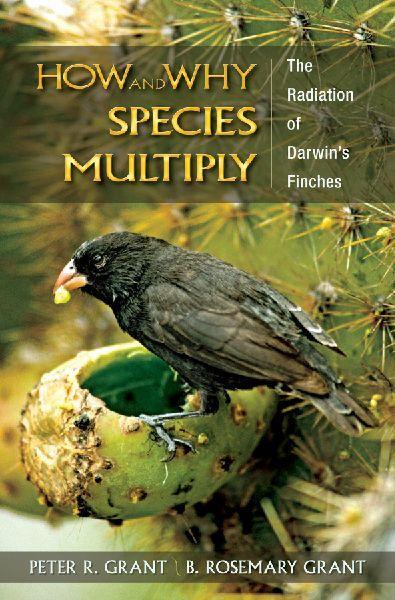
Charles Darwin's experiences in the Galápagos Islands in 1835 helped to guide his thoughts toward a revolutionary theory: that species were not fixed but diversified from their ancestors over many generations, and that the driving mechanism of evolutionary change was natural selection. In this concise, accessible book, Peter and Rosemary Grant explain what we have learned about the origin and evolution of new species through the study of the finches made famous by that great scientist: Darwin's finches. Drawing upon their unique observations of finch evolution over a thirty-four-year period, the Grants trace the evolutionary history of fourteen different species from a shared ancestor three million years ago. They show how repeated cycles of speciation involved adaptive change through natural selection on beak size and shape, and divergence in songs. They explain other factors that drive finch evolution, including geographical isolation, which has kept the Galápagos relatively free of competitors and predators; climate change and an increase in the number of islands over the last three million years, which enhanced opportunities for speciation; and flexibility in the early learning of feeding skills, which helped species to exploit new food resources. Throughout, the Grants show how the laboratory tools of developmental biology and molecular genetics can be combined with observations and experiments on birds in the field to gain deeper insights into why the world is so biologically rich and diverse. Written by two preeminent evolutionary biologists, How and Why Species Multiply helps to answer fundamental questions about evolution--in the Galápagos and throughout the world.
| Themen | Mathematik und Naturwissenschaften Biologie, Biowissenschaften Biowissenschaften, allgemein Evolution / Evolutionsbiologie |
|---|---|
| ISBN | 9780691149998 |
| Sprache | Englisch |
| Erscheinungsdatum | 29.05.2011 |
| Größe | 235 x 154 mm |
| Verlag | Princeton University Press |
| Lieferzeit | Lieferung innerhalb von 28 Werktagen |
| Herstellerangaben | Anzeigen Libri GmbH Europaallee 1 | D-36244 Bad Hersfeld gpsr@libri.de |
Wie gefällt Ihnen unser Shop?