GUTSCHEIN
Bitte haben Sie einen Moment Geduld, wir legen Ihr Produkt in den Warenkorb.
Diese Produkte könnten Sie auch interessieren:
Bitte haben Sie einen Moment Geduld, wir legen Ihr Produkt in den Warenkorb.
| Themen | Gesellschaft und Sozialwissenschaften Psychologie Kognitive Psychologie |
|---|---|
| ISBN | 9780715630679 |
| Sprache | Englisch |
| Erscheinungsdatum | 31.01.2002 |
| Größe | 240 x 161 mm |
| Verlag | Bristol Classical Press |
| Lieferzeit | Lieferung in 7-14 Werktagen |
| Herstellerangaben | Anzeigen Libri GmbH Europaallee 1 | D-36244 Bad Hersfeld gpsr@libri.de |
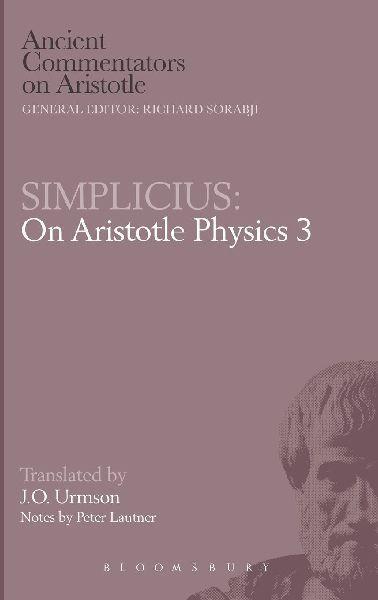
Aristotle's Physics Book 3 covers two subjects: the definition of change and the finitude of the universe. Change enters into the very definition of nature as an internal source of change. Change receives two definitions in chapters 1 and 2, as involving the actualisation of the potential or of the changeable. Alexander of Aphrodisias is reported as thinking that the second version is designed to show that Book 3, like Book 5, means to disqualify change in relations from being genuine change. Aristotle's successor Theophrastus, we are told, and Simplicius himself, prefer to admit relational change. Chapter 3 introduces a general causal principle that the activity of the agent causing change is in the patient undergoing change, and that the causing and undergoing are to be counted as only one activity, however different in definition. Simplicius points out that this paves the way for Aristotle's God who moves the heavens, while admitting no motion in himself. It is also the basis of Aristotle's doctrine, central to Neoplatonism, that intellect is one with the objects it contemplates.In defending Aristotle's claim that the universe is spatially finite, Simplicius has to meet Archytas' question, "What happens at the edge?". He replies that, given Aristotle's definition of place, there is nothing, rather than an empty place, beyond the furthest stars, and one cannot stretch one's hand into nothing, nor be prevented by nothing. But why is Aristotle's beginningless universe not temporally infinite? Simplicius answers that the past years no longer exist, so one never has an infinite collection.
| Themen | Gesellschaft und Sozialwissenschaften Psychologie Kognitive Psychologie |
|---|---|
| ISBN | 9780715630679 |
| Sprache | Englisch |
| Erscheinungsdatum | 31.01.2002 |
| Größe | 240 x 161 mm |
| Verlag | Bristol Classical Press |
| Lieferzeit | Lieferung in 7-14 Werktagen |
| Herstellerangaben | Anzeigen Libri GmbH Europaallee 1 | D-36244 Bad Hersfeld gpsr@libri.de |
Wie gefällt Ihnen unser Shop?