GUTSCHEIN
Bitte haben Sie einen Moment Geduld, wir legen Ihr Produkt in den Warenkorb.
Diese Produkte könnten Sie auch interessieren:
Bitte haben Sie einen Moment Geduld, wir legen Ihr Produkt in den Warenkorb.
| ISBN | 9780813209524 |
|---|---|
| Sprache | Englisch |
| Erscheinungsdatum | 01.04.1999 |
| Größe | 230 x 150 mm |
| Verlag | Catholic University of America Press |
| Lieferzeit | Lieferung innerhalb von 28 Werktagen |
| Herstellerangaben | Anzeigen Libri GmbH Europaallee 1 | D-36244 Bad Hersfeld gpsr@libri.de |
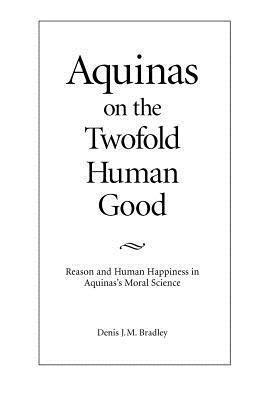
For many years, philosophers have read Aquinas's ethical writings as if his moral doctrine ought to make sense completely apart from the commitments of Christian faith. Because Aquinas relied heavily upon rational arguments, and upon Aristotle in particular, scholars have frequently attempted to read his texts in a strictly philosophical context. According to Denis J. M. Bradley, this approach is misguided and can lead to a radical misinterpretation of Aquinas's moral science. Here, Bradley sets out to prove that Aquinas was a theologian before all else and that any systematic Thomistic ethics must remain theological—not philosophical.Against the background of Aristotle's Nicomachean Ethics, the author provides a detailed differentiation between Aristotle's and Aquinas's views on moral principles and the end of man. He points out that Aquinas himself provided a powerful critique of remaining within the limits of Aristotelian philosophical naturalism in ethics. Human nature's openness to its de facto supernatural end, which is the focal point of Thomistic moral science, obviates any attempt to reconstruct a systematic, quasi-Aristotelian ethics from the extracted elements of Aquinas's moral science. Aquinas's critique of Aristotle leads to a paradoxical philosophical conception of human nature: short of attaining its ultimate supernatural end, the gratuitous vision of the divine essence, human nature in history and even in eternity is naturally endless.In concluding, Bradley suggests that it is the Christian philosopher who, by explicitly embracing the theological meaning of man's paradoxical natural endlessness, can best engage a postmodernism that repudiates any ultimate rational grounds for human thought and morality.
| ISBN | 9780813209524 |
|---|---|
| Sprache | Englisch |
| Erscheinungsdatum | 01.04.1999 |
| Größe | 230 x 150 mm |
| Verlag | Catholic University of America Press |
| Lieferzeit | Lieferung innerhalb von 28 Werktagen |
| Herstellerangaben | Anzeigen Libri GmbH Europaallee 1 | D-36244 Bad Hersfeld gpsr@libri.de |
Wie gefällt Ihnen unser Shop?