GUTSCHEIN
Bitte haben Sie einen Moment Geduld, wir legen Ihr Produkt in den Warenkorb.
Diese Produkte könnten Sie auch interessieren:
Bitte haben Sie einen Moment Geduld, wir legen Ihr Produkt in den Warenkorb.
| Themen | Mathematik und Naturwissenschaften Chemie Physikalische Chemie Quanten- und theoretische Chemie |
|---|---|
| ISBN | 9780854041442 |
| Sprache | Englisch |
| Erscheinungsdatum | 29.09.2008 |
| Größe | 236 x 157 mm |
| Verlag | RSC Publishing |
| Herausgegeben von | Alex Tropsha, Alexandre Varnek |
| Lieferzeit | Lieferung innerhalb von 28 Werktagen |
| Herstellerangaben | Anzeigen Libri GmbH Europaallee 1 | D-36244 Bad Hersfeld gpsr@libri.de |
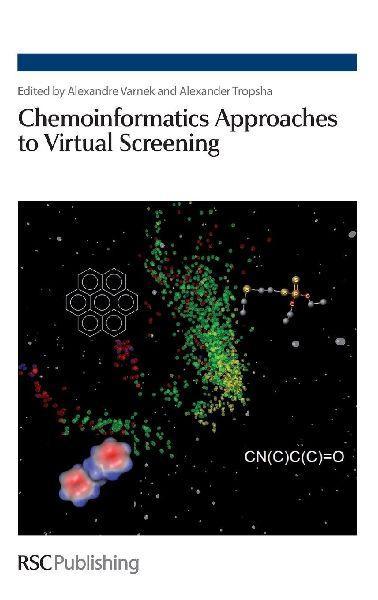
Virtual screening is commonly associated with methodologies that rely on the explicit knowledge of 3D structure of the target protein to identify potential bioactive compounds. This book is the first monograph to summarize the innovative applications of efficient chemoinformatics approaches towards screening large chemical libraries. The focus on virtual screening expands chemoinformatics beyond its traditional boundaries as a synthetic and data-analytical area of research towards its recognition as a predictive and decision-support scientific discipline. The monograph covers chemoinformatics approaches applicable to virtual screening of very large collections of chemical compounds to identify novel biologically active molecules. The discussed approaches rely on chemoinformatics concepts such as the representation of molecules using multiple descriptors of chemical structures, advanced chemical similarity calculations in multidimensional descriptor spaces, and machine learning and data mining approaches. Ligand-based approaches, which are in the focus of this work, are more computationally efficient compared to structure-based virtual screening. Chemoinformatics: An Approach to Virtual Screening opens with the overview of modern methods of compounds library design, followed by a chapter devoted to molecular similarity analysis. Four sections describe virtual screening based on the using of molecular fragments, 2D pharmacophores and 3D pharmacophores. Application of fuzzy pharmacophores for libraries design is the subject of the next chapter, followed by a chapter dealing with QSAR studies based on local molecular parameters. Probabilistic approaches based on 2D descriptors in the assessment of biological activities are also described with an overview of the modern methods and software for ADME prediction. The final chapter describes the new approach of coding the receptor binding sites and their respective ligands in multidimensional chemical descriptor space which affords an interesting and efficient alternative to traditional docking and screening techniques. The focus on extending the experiences accumulated in traditional areas of chemoinformatics research such as Quantitative Structure Activity Relationships (QSAR) or chemical similarity searching towards virtual screening make the theme of this monograph essential reading for researchers in the area of computer-aided drug discovery. Due to its generic data-analytical focus there will be a growing application of chemoinformatics approaches in multiple areas of chemical and biological research such as synthesis planning, nanotechnology, proteomics, physical and analytical chemistry and chemical genomics.
| Themen | Mathematik und Naturwissenschaften Chemie Physikalische Chemie Quanten- und theoretische Chemie |
|---|---|
| ISBN | 9780854041442 |
| Sprache | Englisch |
| Erscheinungsdatum | 29.09.2008 |
| Größe | 236 x 157 mm |
| Verlag | RSC Publishing |
| Herausgegeben von | Alex Tropsha, Alexandre Varnek |
| Lieferzeit | Lieferung innerhalb von 28 Werktagen |
| Herstellerangaben | Anzeigen Libri GmbH Europaallee 1 | D-36244 Bad Hersfeld gpsr@libri.de |
Wie gefällt Ihnen unser Shop?