GUTSCHEIN
Bitte haben Sie einen Moment Geduld, wir legen Ihr Produkt in den Warenkorb.
Diese Produkte könnten Sie auch interessieren:
Bitte haben Sie einen Moment Geduld, wir legen Ihr Produkt in den Warenkorb.
| Themen | Gesellschaft und Sozialwissenschaften Pädagogik / Erziehungswissenschaften Fachspezifischer Unterricht |
|---|---|
| ISBN | 9781458329264 |
| Sprache | Englisch |
| Erscheinungsdatum | 20.03.2022 |
| Größe | 210 x 148 mm |
| Verlag | Lulu.com |
| Lieferzeit | Lieferung in 7-14 Werktagen |
| Herstellerangaben | Anzeigen Libri GmbH Europaallee 1 | D-36244 Bad Hersfeld gpsr@libri.de |
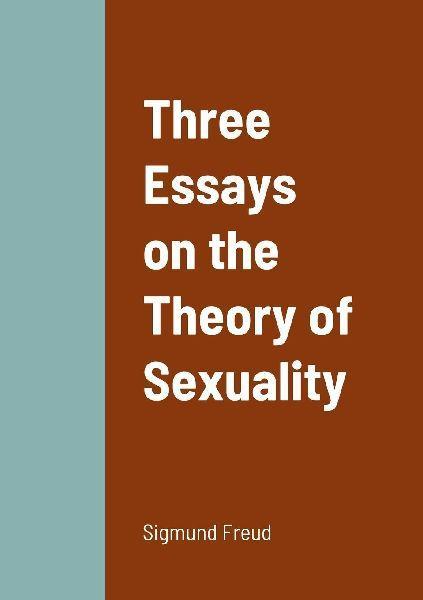
Three Essays on the Theory of Sexuality by Sigmund FreudThree Essays on the Theory of Sexuality (German: Drei Abhandlungen zur Sexualtheorie), sometimes titled Three Contributions to the Theory of Sex, is a 1905 work by Sigmund Freud, the founder of psychoanalysis, in which the author advances his theory of sexuality, in particular its relation to childhood.Freud's book covered three main areas: sexual perversions childhood sexuality and puberty.The Sexual AberrationsFreud began his first essay, on "The Sexual Aberrations", by distinguishing between the sexual object and the sexual aim - noting that deviations from the norm could occur with respect to both. The sexual object is therein defined as a desired object, and the sexual aim as what acts are desired with said object.Discussing the choice of children and animals as sex objects - pedophilia and bestiality - he notes that most people would prefer to limit these perversions to the insane "on aesthetic grounds" but that they exist in normal people also. He also explores deviations of sexual aims, as in the tendency to linger over preparatory sexual aspects such as looking and touching.Turning to neurotics, Freud emphasised that "in them tendencies to every kind of perversion can be shown to exist as unconscious forces...neurosis is, as it were, the negative of perversion". Freud also makes the point that people who are behaviorally abnormal are always sexually abnormal in his experience but that many people who are normal behaviorally otherwise are sexually abnormal also.Freud concluded that "a disposition to perversions is an original and universal disposition of the human sexual instinct and that...this postulated constitution, containing the germs of all the perversions, will only be demonstrable in children".Infantile SexualityHis second essay, on "Infantile Sexuality", argues that children have sexual urges, from which adult sexuality only gradually emerges via psychosexual development.Looking at children, Freud identified many forms of infantile sexual emotions, including thumb sucking, autoeroticism, and sibling rivalry.The Transformations of PubertyIn his third essay, "The Transformations of Puberty" Freud formalised the distinction between the 'fore-pleasures' of infantile sexuality and the 'end-pleasure' of sexual intercourse.He also demonstrated how the adolescent years consolidate sexual identity under the dominance of the genitals.
| Themen | Gesellschaft und Sozialwissenschaften Pädagogik / Erziehungswissenschaften Fachspezifischer Unterricht |
|---|---|
| ISBN | 9781458329264 |
| Sprache | Englisch |
| Erscheinungsdatum | 20.03.2022 |
| Größe | 210 x 148 mm |
| Verlag | Lulu.com |
| Lieferzeit | Lieferung in 7-14 Werktagen |
| Herstellerangaben | Anzeigen Libri GmbH Europaallee 1 | D-36244 Bad Hersfeld gpsr@libri.de |
Wie gefällt Ihnen unser Shop?