Bitte haben Sie einen Moment Geduld, wir legen Ihr Produkt in den Warenkorb.
Diese Produkte könnten Sie auch interessieren:
Bitte haben Sie einen Moment Geduld, wir legen Ihr Produkt in den Warenkorb.
| Reihe | The Springer International Series in Engineering and Computer Science |
|---|---|
| ISBN | 9781461292005 |
| Sprache | Englisch |
| Erscheinungsdatum | 12.10.2011 |
| Genre | Technik/Elektronik, Elektrotechnik, Nachrichtentechnik |
| Verlag | Springer US |
| Lieferzeit | Lieferbar in 6 Werktagen |
| Herstellerangaben | Anzeigen Springer Nature Customer Service Center GmbH Europaplatz 3 | DE-69115 Heidelberg ProductSafety@springernature.com |
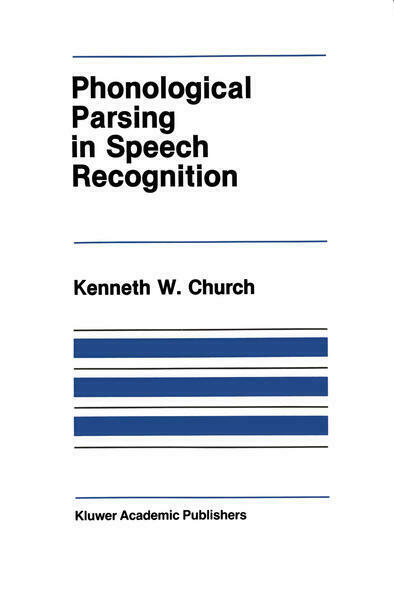
It is well-known that phonemes have different acoustic realizations depending on the context. Thus, for example, the phoneme /t! is typically realized with a heavily aspirated strong burst at the beginning of a syllable as in the word Tom, but without a burst at the end of a syllable in a word like cat. Variation such as this is often considered to be problematic for speech recogni tion: (1) "In most systems for sentence recognition, such modifications must be viewed as a kind of 'noise' that makes it more difficult to hypothesize lexical candidates given an in put phonetic transcription. To see that this must be the case, we note that each phonological rule [in a certain example] results in irreversible ambiguity-the phonological rule does not have a unique inverse that could be used to recover the underlying phonemic representation for a lexical item. For example, . . . schwa vowels could be the first vowel in a word like 'about' or the surface realization of almost any English vowel appearing in a sufficiently destressed word. The tongue flap [(] could have come from a /t! or a /d/. " [65, pp. 548-549] This view of allophonic variation is representative of much of the speech recognition literature, especially during the late 1970's. One can find similar statements by Cole and Jakimik [22] and by Jelinek [50].
| Reihe | The Springer International Series in Engineering and Computer Science |
|---|---|
| ISBN | 9781461292005 |
| Sprache | Englisch |
| Erscheinungsdatum | 12.10.2011 |
| Genre | Technik/Elektronik, Elektrotechnik, Nachrichtentechnik |
| Verlag | Springer US |
| Lieferzeit | Lieferbar in 6 Werktagen |
| Herstellerangaben | Anzeigen Springer Nature Customer Service Center GmbH Europaplatz 3 | DE-69115 Heidelberg ProductSafety@springernature.com |
Wie gefällt Ihnen unser Shop?