GUTSCHEIN
Bitte haben Sie einen Moment Geduld, wir legen Ihr Produkt in den Warenkorb.
Diese Produkte könnten Sie auch interessieren:
Bitte haben Sie einen Moment Geduld, wir legen Ihr Produkt in den Warenkorb.
| Reihe | World Bank Publications |
|---|---|
| ISBN | 9781464803147 |
| Sprache | Englisch |
| Erscheinungsdatum | 29.10.2014 |
| Größe | 254 x 178 mm |
| Verlag | World Bank Publications |
| Lieferzeit | Lieferung in 7-14 Werktagen |
| Herstellerangaben | Anzeigen gpsr@mare-nostrum.co.uk |
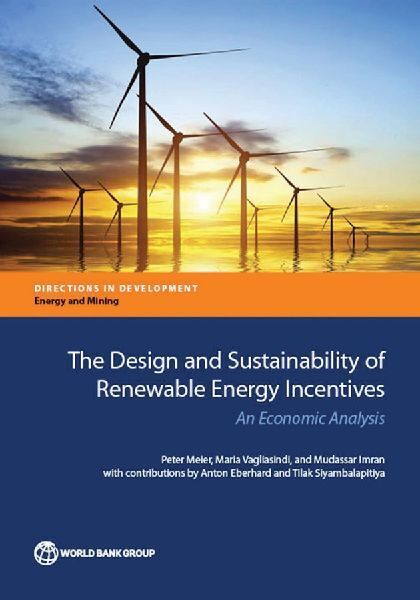
The novelty of this work is the fact that it introduces a rigorous and objective economic perspective of current renewable energy support mechanisms and an empirical analysis of the strengths and weaknesses of these mechanisms, which is much needed in a debate often dominated by widespread misconceptions. The economic rationale for renewable energy is straightforward: the optimum amount of renewable energy for grid-connected generation is given by the intersection of the renewable energy supply curve with the avoided cost of thermal electricity generation.The proposed analytical framework: (i) differentiates and illustrates trade-offs-among local, regional, and national impacts, in the short and long run; (ii) captures distributional impacts; and (iii) captures externalities and compares alternative projects based on equivalent output and cost. Accordingly, the study advocates for the need to get the economic, financial, and institutional basics right for the deployment of renewable energy. The study's integration of renewable energy subsidies with fossil subsidies is another novel and important contribution. This allows important comparisons. For example, to reduce carbon intensity in developing country economies, is it more efficient to deploy renewable energy or implement alternative options, such as eliminating subsidies on fossil fuels?The work is based on case studies of Vietnam, Indonesia, Sri Lanka, South Africa, Tanzania, Egypt, Brazil, and Turkey, selected to provide a representative sample of countries with different energy endowments (coal, natural gas, and hydro-based systems) and policy incentives (from feed-in tariffs to auctions).Along the way, the incremental cost of renewable energy is compared with the average cost of generation. The selection and design of support mechanisms in turn determines the impacts on the budget and residential consumers.The main lessons emerging from the case studies are that successful renewable energy policies:Will only be effective once the state-owned utilities who are the buyers of grid-connected renewable energy are themselves in good financial healthNeed to be grounded in economic analysis and accompanied by the application of market principles to ensure economic efficiencyRequire a sustainable, equitable, and transparent recovery of incremental costs
| Reihe | World Bank Publications |
|---|---|
| ISBN | 9781464803147 |
| Sprache | Englisch |
| Erscheinungsdatum | 29.10.2014 |
| Größe | 254 x 178 mm |
| Verlag | World Bank Publications |
| Lieferzeit | Lieferung in 7-14 Werktagen |
| Herstellerangaben | Anzeigen gpsr@mare-nostrum.co.uk |
Wie gefällt Ihnen unser Shop?