GUTSCHEIN
Bitte haben Sie einen Moment Geduld, wir legen Ihr Produkt in den Warenkorb.
Diese Produkte könnten Sie auch interessieren:
Bitte haben Sie einen Moment Geduld, wir legen Ihr Produkt in den Warenkorb.
| Themen | Philosophie und Religion Philosophie Philosophische Traditionen und Denkschulen |
|---|---|
| ISBN | 9781472557377 |
| Sprache | Englisch |
| Erscheinungsdatum | 10.04.2014 |
| Größe | 234 x 156 mm |
| Verlag | Bloomsbury 3PL |
| Lieferzeit | Lieferung in 7-14 Werktagen |
| Herstellerangaben | Anzeigen Libri GmbH Europaallee 1 | D-36244 Bad Hersfeld gpsr@libri.de |
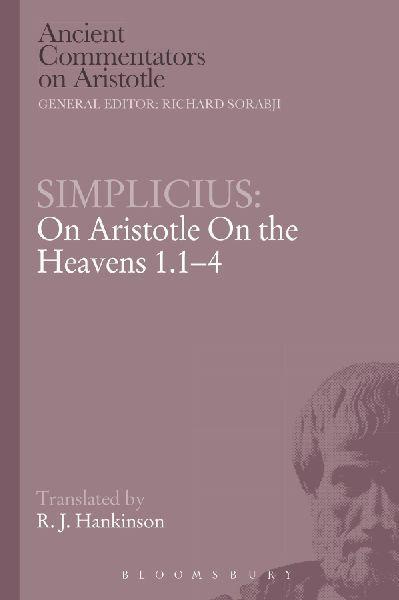
In chapter 1 of On the Heavens Aristotle defines body, and then notoriously ruptures dynamics by introducing a fifth element, beyond Plato's four, to explain the rotation of the heavens, which, like nearly all Greeks, Aristotle took to be real, not apparent. Even a member of his school, Xenarchus, we are told, rejected his fifth element. The Neoplatonist Simplicius seeks to harmonise Plato and Aristotle. Plato, he says, thought that the heavens were composed of all four elements but with the purest kind of fire, namely light, predominating. That Plato would not mind this being called a fifth element is shown by his associating with the heavens the fifth of the five convex regular solids recognised by geometry. Simplicius follows Aristotle's view that one of the lower elements, fire, also rotates, as shown by the behaviour of comets. But such motion, though natural for the fifth elements, is super-natural for fire. Simplicius reveals that the Aristotelian Alexander of Aphrodisias recognised the need to supplement Aristotle and account for the annual approach and retreat of planets by means of Ptolemy's epicycles or eccentrics. Aristotle's philosopher-god is turned by Simplicius, following his teacher Ammonius, into a creator-god, like Plato's. But the creation is beginningless, as shown by the argument that, if you try to imagine a time when it began, you cannot answer the question, 'Why not sooner?' In explaining the creation, Simplicius follows the Neoplatonist expansion of Aristotle's four 'causes' to six. The final result gives us a cosmology very considerably removed from Aristotle's.
| Themen | Philosophie und Religion Philosophie Philosophische Traditionen und Denkschulen |
|---|---|
| ISBN | 9781472557377 |
| Sprache | Englisch |
| Erscheinungsdatum | 10.04.2014 |
| Größe | 234 x 156 mm |
| Verlag | Bloomsbury 3PL |
| Lieferzeit | Lieferung in 7-14 Werktagen |
| Herstellerangaben | Anzeigen Libri GmbH Europaallee 1 | D-36244 Bad Hersfeld gpsr@libri.de |
Wie gefällt Ihnen unser Shop?