GUTSCHEIN
Bitte haben Sie einen Moment Geduld, wir legen Ihr Produkt in den Warenkorb.
Diese Produkte könnten Sie auch interessieren:
Bitte haben Sie einen Moment Geduld, wir legen Ihr Produkt in den Warenkorb.
| Reihe | Methods in Molecular Biology |
|---|---|
| Themen | Mathematik und Naturwissenschaften Biologie, Biowissenschaften Biochemie |
| ISBN | 9781617370427 |
| Sprache | Englisch |
| Erscheinungsdatum | 10.11.2010 |
| Größe | 229 x 152 mm |
| Verlag | Humana |
| Herausgegeben von | David M. L. Morgan |
| Lieferzeit | Lieferung in 7-14 Werktagen |
| Herstellerangaben | Anzeigen Europaplatz 3 | DE-69115 Heidelberg ProductSafety@springernature.com |
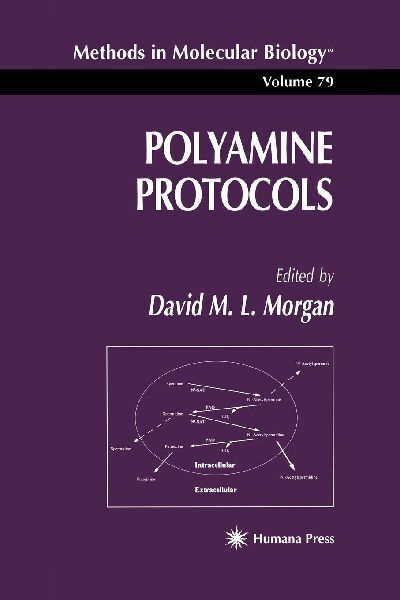
Putrescine and spermidine are ubiquitous in living organisms. Spermine, third of the three most commonly occurring natural polyamines, is probably present in all eukaryotes but is rare (or nonexistent) in prokaryotes. Polyamine residues are constituents of many compounds found in plants and insects. Putrescine, spermidine, or spermine-containing alkaloids are found in many plants, nonproteinaceous spider and wasp toxins contain polyamine residues, and glutathionyl-spermidine conjugates have been found in some pathogenic microorganisms. In most cells polyamines are the products of a highly regulated bios- thetic pathway. It is not clear whether the elaborate regulation of polyamine synthesis is a consequence of their essential role(s) in cellular differentiation and development, or part of a defense mechanism to prevent overaccumulation of compounds that are toxic in excess. In addition to their biosynthetic capa bility, many cells also possess transport systems for polyamines that respond to intracellular polyamine levels, and other stimuli, and are regulated by mecha nisms that are at present incompletely defined. Two routes of polyamine catabolism have been identified in mammalian cells, a biodegradative route and a recycling pathway. The relative impor tance of these pathways and their overall regulation is only partially resolved. What is clear is the widespread occurrence of a variety of polyamine-oxid- ing enzymes in animals, plants, bacteria, and fungi. Polyamine catabolism, by whichever route, results in the formation of aminoaldehydes as intermediates.
| Reihe | Methods in Molecular Biology |
|---|---|
| Themen | Mathematik und Naturwissenschaften Biologie, Biowissenschaften Biochemie |
| ISBN | 9781617370427 |
| Sprache | Englisch |
| Erscheinungsdatum | 10.11.2010 |
| Größe | 229 x 152 mm |
| Verlag | Humana |
| Herausgegeben von | David M. L. Morgan |
| Lieferzeit | Lieferung in 7-14 Werktagen |
| Herstellerangaben | Anzeigen Europaplatz 3 | DE-69115 Heidelberg ProductSafety@springernature.com |
Wie gefällt Ihnen unser Shop?