GUTSCHEIN
Bitte haben Sie einen Moment Geduld, wir legen Ihr Produkt in den Warenkorb.
Diese Produkte könnten Sie auch interessieren:
Bitte haben Sie einen Moment Geduld, wir legen Ihr Produkt in den Warenkorb.
| Themen | Technologie, Ingenieurswissenschaft, Landwirtschaft, Industrieprozesse Technologie, allgemein Ingenieurswesen, Maschinenbau allgemein |
|---|---|
| ISBN | 9781919135007 |
| Sprache | Englisch |
| Erscheinungsdatum | 18.09.2026 |
| Größe | 254 x 178 mm |
| Verlag | Opentask |
| Lieferzeit | Lieferung innerhalb von 28 Werktagen |
| Herstellerangaben | Anzeigen Libri GmbH Europaallee 1 | D-36244 Bad Hersfeld gpsr@libri.de |
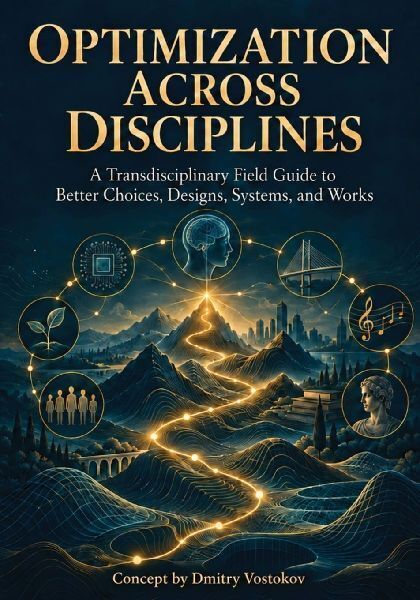
We can think of optimization as choosing among alternatives under constraints. Similar structures appear in different disciplines, although the objects, criteria, and meanings may differ. For example, allocating computing resources, selecting a medical intervention, and revising a musical composition involve different interpretations of what constitutes an improvement.In Optimization Across Disciplines, we examine these connections across mathematics, computing, engineering, living systems, society, and creative work. We begin with fundamental concepts and proceed to methods and worked examples. These include black-box optimization, where we evaluate candidate solutions without direct access to the objective's internal structure. We also use category theory to examine composition and the conditions under which a relationship can be carried from one domain to another.The book includes illustrations, method cards, a glossary, an index, and references for further study. A mathematics companion develops the prerequisites from school foundations to advanced topics. An equation atlas connects the formulas in the main text with explanations of their symbols and meaning.Throughout the book, we consider how objectives are chosen, what evidence supports a result, and what a model leaves out. We also examine situations where further optimization is inappropriate, including when goals change, measurements distort behavior, or important values cannot be represented by a single score.In a bonus article, we consider optimization in software diagnostics, observability, memory dump analysis, trace and log analysis, and debugging. Optimization applies to both software behavior and the process used to explain it. We may collect more data, run additional debugger commands, or introduce another measurement, but each action has a cost. Its usefulness depends on the diagnostic question and the decision it may change.Using analysis patterns, we examine evidence selection, competing mechanisms, and controlled intervention. Memory dumps and execution traces provide different projections of software execution, and their combined evidence may answer questions that either artifact leaves unresolved. We introduce a formal model based on expected decision loss and value of information, then relate it to practical choices about instrumentation, sampling, artifact acquisition, and analysis.A worked latency example follows the process from initial hypotheses to a reversible software change. We also consider incomplete evidence, measurement effects, reduced failure reproductions, and conditions for stopping an investigation. Throughout the article, we retain the assumptions and uncertainty behind each conclusion and specify what a proposed improvement must preserve.
| Themen | Technologie, Ingenieurswissenschaft, Landwirtschaft, Industrieprozesse Technologie, allgemein Ingenieurswesen, Maschinenbau allgemein |
|---|---|
| ISBN | 9781919135007 |
| Sprache | Englisch |
| Erscheinungsdatum | 18.09.2026 |
| Größe | 254 x 178 mm |
| Verlag | Opentask |
| Lieferzeit | Lieferung innerhalb von 28 Werktagen |
| Herstellerangaben | Anzeigen Libri GmbH Europaallee 1 | D-36244 Bad Hersfeld gpsr@libri.de |
Wie gefällt Ihnen unser Shop?