GUTSCHEIN
Bitte haben Sie einen Moment Geduld, wir legen Ihr Produkt in den Warenkorb.
Diese Produkte könnten Sie auch interessieren:
Bitte haben Sie einen Moment Geduld, wir legen Ihr Produkt in den Warenkorb.
| Themen | Medizin Klinische und Innere Medizin Krankheiten und Störungen Immunologie |
|---|---|
| ISBN | 9782528544495 |
| Sprache | Englisch |
| Erscheinungsdatum | 14.09.2026 |
| Größe | 280 x 216 mm |
| Verlag | W.F |
| Lieferzeit | Lieferung in 7-14 Werktagen |
| Herstellerangaben | Anzeigen Libri GmbH Europaallee 1 | D-36244 Bad Hersfeld gpsr@libri.de |
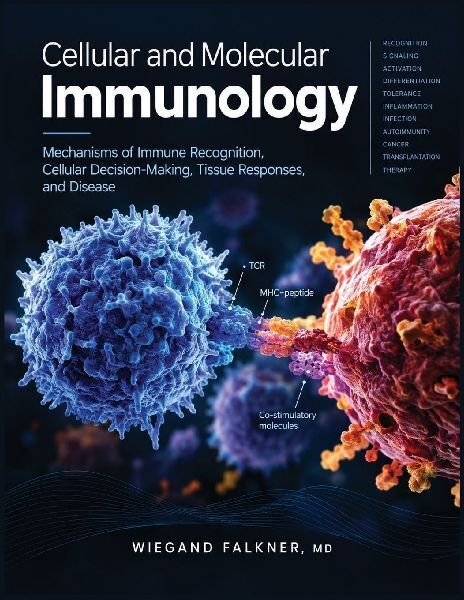
Immunology is not a catalog of cells, cytokines, receptors, and pathways. It is the study of how biological information is recognized, interpreted, and converted into action.Cellular and Molecular Immunology examines the immune system at precisely that level: how molecular signals become cellular decisions, how those decisions lead to tissue responses, and how their failure or redirection result in disease.The book is built around a mechanistic question that remains central across immunology: what information does an immune cell receive, how is that information integrated, and why does the cell respond in one way rather than another?That question provides a consistent framework for understanding innate immune sensing, antigen recognition, signal transduction, lymphocyte development, immune tolerance, inflammation, cellular differentiation, antibody responses, immunological memory, tissue immunity, and immune-mediated pathology.Molecular mechanisms are examined where they determine biological behavior. TCR and BCR signaling, JAK-STAT, NF-¿B, MAPK, PI3K-AKT-mTOR, complement, interferon signaling, inflammasomes, antigen processing, MHC biology, V(D)J recombination, costimulation, inhibitory signaling, and metabolic regulation are treated as functional mechanisms rather than disconnected pathways to memorize.The same logic is carried into disease.Autoimmunity is examined as a failure of tolerance and regulatory control. Immunodeficiency is approached through the specific immune function that has been lost and the phenotype that follows. Infection is analyzed according to the pathogen's location, replication strategy, immune evasion mechanisms, and the balance between microbial control and tissue injury. Cancer is considered within the reciprocal relationship between tumor evolution and immune selection. Transplantation is framed through allorecognition, rejection, tolerance, and the consequences of donor-recipient immune conflict.The final part connects these mechanisms to immune-based medicine: monoclonal and bispecific antibodies, cytokine-targeted therapy, checkpoint blockade, cellular immunotherapies, vaccines, immune biomarkers, immune-repertoire analysis, single-cell technologies, and precision immunology.The objective is not to make immunology simpler by removing its complexity. It is to make that complexity structurally intelligible.
| Themen | Medizin Klinische und Innere Medizin Krankheiten und Störungen Immunologie |
|---|---|
| ISBN | 9782528544495 |
| Sprache | Englisch |
| Erscheinungsdatum | 14.09.2026 |
| Größe | 280 x 216 mm |
| Verlag | W.F |
| Lieferzeit | Lieferung in 7-14 Werktagen |
| Herstellerangaben | Anzeigen Libri GmbH Europaallee 1 | D-36244 Bad Hersfeld gpsr@libri.de |
Wie gefällt Ihnen unser Shop?