GUTSCHEIN
Bitte haben Sie einen Moment Geduld, wir legen Ihr Produkt in den Warenkorb.
Diese Produkte könnten Sie auch interessieren:
Bitte haben Sie einen Moment Geduld, wir legen Ihr Produkt in den Warenkorb.
| Reihe | SpringerBriefs in Materials |
|---|---|
| Themen | Technologie, Ingenieurswissenschaft, Landwirtschaft, Industrieprozesse Maschinenbau und Werkstoffe Materialwissenschaft |
| ISBN | 9783319329864 |
| Sprache | Englisch |
| Erscheinungsdatum | 06.09.2016 |
| Größe | 23.5 x 15.5 cm |
| Verlag | Springer International Publishing |
| Lieferzeit | Lieferung in 7-14 Werktagen |
| Herstellerangaben | Anzeigen Springer Nature Customer Service Center GmbH Europaplatz 3 | DE-69115 Heidelberg ProductSafety@springernature.com |
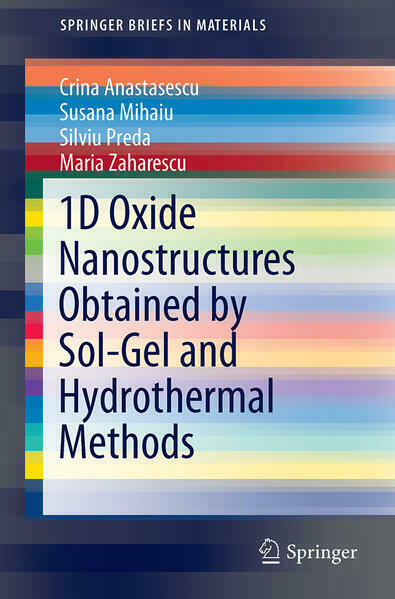
This book presents wet chemical sol-gel and hydrothermal methods for 1D oxide nanostructure preparation. These methods represent an attractive route to multifunctional nanomaterials synthesis, as they are versatile, inexpensive and, thus, appropriate for obtaining a wide range of oxide materials with tailored morphology and properties. Three specific oxides (SiO2, TiO2, ZnO) are discussed in detail in order to illustrate the principle of the sol-gel and hydrothermal preparation of 1D oxide nanostructures. Other oxides synthesized via this method are also briefly presented. Throughout the book, the correlation between the tubular structure and the physico-chemical properties of these materials is highlighted. 1D oxide nanostructures exhibit interesting optical and electrical properties, due to their confined morphology. In addition, a well-defined geometry can be associated with chemically active species. For example, the pure SiO2 nanotubes presented a slight photocatalytic activity, while the Pt-doped SiO2 tubular materials act as microreactors in catalytic reactions. In the case of titania and titanate nanotubes, large specific surface area and pore volume, ion-exchange ability, enhanced light absorption, and fast electron-transport capability have attracted significant research interest. The chemical and physical modifications (microwave assisted hydrothermal methods) discussed here improve the formation kinetics of the nanotubes. The ZnO nanorods/tubes were prepared as random particles or as large areas of small, oriented 1D ZnO nanostructures on a variety of substrates. In the latter case a sol-gel layer is deposited on the substrate prior to the hydrothermal preparation. Using appropriate dopants, coatings of ZnO nanorods with controlled electrical behavior can be obtained.
| Reihe | SpringerBriefs in Materials |
|---|---|
| Themen | Technologie, Ingenieurswissenschaft, Landwirtschaft, Industrieprozesse Maschinenbau und Werkstoffe Materialwissenschaft |
| ISBN | 9783319329864 |
| Sprache | Englisch |
| Erscheinungsdatum | 06.09.2016 |
| Größe | 23.5 x 15.5 cm |
| Verlag | Springer International Publishing |
| Lieferzeit | Lieferung in 7-14 Werktagen |
| Herstellerangaben | Anzeigen Springer Nature Customer Service Center GmbH Europaplatz 3 | DE-69115 Heidelberg ProductSafety@springernature.com |
Wie gefällt Ihnen unser Shop?