GUTSCHEIN
Bitte haben Sie einen Moment Geduld, wir legen Ihr Produkt in den Warenkorb.
Diese Produkte könnten Sie auch interessieren:
Auch verfügbar als:
Bitte haben Sie einen Moment Geduld, wir legen Ihr Produkt in den Warenkorb.
| Reihe | Cultural Psychology of Education |
|---|---|
| Themen | Gesellschaft und Sozialwissenschaften Pädagogik / Erziehungswissenschaften Pädagogische Psychologie |
| ISBN | 9783319398679 |
| Sprache | Englisch |
| Erscheinungsdatum | 29.08.2016 |
| Größe | 23.5 x 15.5 cm |
| Verlag | Springer International Publishing |
| Lieferzeit | Lieferung in 7-14 Werktagen |
| Herstellerangaben | Anzeigen Springer Nature Customer Service Center GmbH Europaplatz 3 | DE-69115 Heidelberg ProductSafety@springernature.com |
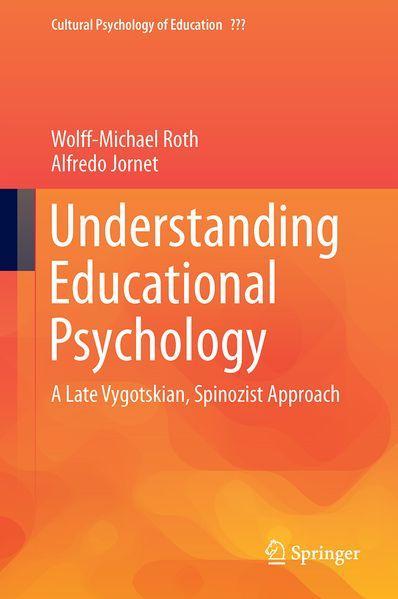
This book takes up the agenda of the late (but unknown) L. S. Vygotsky, who had turned to the philosopher Spinoza to develop a holistic approach to psychology, an approach that no longer dichotomized the body and mind, intellect and affect, or the individual and the social. In this approach, there is only one substance, which manifests itself in different ways in the thinking body, including as biology and culture. The manifestation as culture is premised on the existence of the social.
In much of current educational psychology, there are unresolved contradictions that have their origin in the opposition between body and mind, individual and collective, and structure and process—including the different nature of intellect and affect or the difference between knowledge and its application. Many of the same contradictions are repeated in constructivist approaches, which do not overcome dichotomies but rather acerbate them by individualizing and intellectualizing our knowledgeable participation in recognizably exhibiting and producing the everyday cultural world. Interestingly enough, L. S. Vygotsky, who is often used as a referent for making arguments about inter- and intrasubjective “mental” “constructions,” developed, towards the end of his life, a Spinozist approach according to which there is only one substance. This one substance manifests itself in two radically different ways: body (material, biology) and mind (society, culture). But there are not two substances that are combined into a unit; there is only one substance. Once such an approach is adopted, the classical question of cognitive scientists about how symbols are grounded in the world comes to be recognized as an artefact of the theory. Drawing on empirical materials from different learning settings—including parent-child, school, and workplace settings—this book explores the opportunities and implications that this non-dualist approach has for educational research and practice.| Reihe | Cultural Psychology of Education |
|---|---|
| Themen | Gesellschaft und Sozialwissenschaften Pädagogik / Erziehungswissenschaften Pädagogische Psychologie |
| ISBN | 9783319398679 |
| Sprache | Englisch |
| Erscheinungsdatum | 29.08.2016 |
| Größe | 23.5 x 15.5 cm |
| Verlag | Springer International Publishing |
| Lieferzeit | Lieferung in 7-14 Werktagen |
| Herstellerangaben | Anzeigen Springer Nature Customer Service Center GmbH Europaplatz 3 | DE-69115 Heidelberg ProductSafety@springernature.com |
Wie gefällt Ihnen unser Shop?