GUTSCHEIN
Bitte haben Sie einen Moment Geduld, wir legen Ihr Produkt in den Warenkorb.
Diese Produkte könnten Sie auch interessieren:
Bitte haben Sie einen Moment Geduld, wir legen Ihr Produkt in den Warenkorb.
| Reihe | Forschungen zur Religion und Literatur des Alten und Neuen Testaments |
|---|---|
| Themen | Philosophie und Religion Religion und Glaube Christentum |
| ISBN | 9783525540435 |
| Sprache | Englisch |
| Erscheinungsdatum | 20.05.2015 |
| Größe | 23.7 x 16 cm |
| Verlag | Vandenhoeck & Ruprecht |
| Lieferzeit | Lieferbar in 14 Werktagen |
| Herstellerangaben | Anzeigen Brill Deutschland GmbH productsafety@degruyterbrill.com |
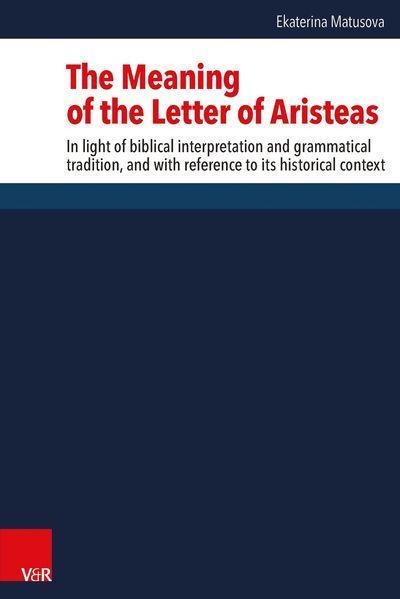
Ekaterin Matusova offers a new approach to the old problems of interpretation of the “Letter of Aristeas”.Chapter 1 deals with the question of the structure of the narrative. Matusova argues that at the time of Aristeas compositions of the kind of the Reworked Pentateuch, or Rewritten Bible were circulating in Egypt in parallel with the LXX and were a source of interpretations of the Hebrew text different from the LXX and of specific combinations of subjects popular in Second Temple Judaism. In particular, Matusova further argues that the leading principle of the composition of the Letter is that of the Reworked Deuteronomy, where subjects referring to the idea of following the Law among the gentiles were grouped together. The analysis is based on a broad circle of Jewish sources, including Philo of Alexandria and documents from the Qumran library. The principle of the composition discovered in this part of the study is referred to as the Jewish paradigm.Chapter 2 offers a new interpretation of the frame story in the narrative, i.e. of the story of the translation in the strict sense. Matusova shows that two paradigms are skilfully combined in this split story: the Jewish one, based on the Bible, and the Greek one, which involves Greek grammatical theory. She further argues that the story, when read in terms of Greek grammar, turns out to be a consistent story not of the translation, but of the correction of the LXX, which is important for our understanding of the early history of the translation. The analysis involves extensive excurses into Greek grammatical theory, including a discussion of Aristotle, Dionysius Thrax and other Hellenistic grammarians.In Chapter 3 Matusova tries to find the reason for the combination of these two paradigms, namely the Jewish biblical paradigm and the Greek grammatical ones, and to interpret their interconnected meaning, by placing it in the broad historical context of the Ptolemaic state
| Reihe | Forschungen zur Religion und Literatur des Alten und Neuen Testaments |
|---|---|
| Themen | Philosophie und Religion Religion und Glaube Christentum |
| ISBN | 9783525540435 |
| Sprache | Englisch |
| Erscheinungsdatum | 20.05.2015 |
| Größe | 23.7 x 16 cm |
| Verlag | Vandenhoeck & Ruprecht |
| Lieferzeit | Lieferbar in 14 Werktagen |
| Herstellerangaben | Anzeigen Brill Deutschland GmbH productsafety@degruyterbrill.com |
Wie gefällt Ihnen unser Shop?