GUTSCHEIN
Bitte haben Sie einen Moment Geduld, wir legen Ihr Produkt in den Warenkorb.
Diese Produkte könnten Sie auch interessieren:
Bitte haben Sie einen Moment Geduld, wir legen Ihr Produkt in den Warenkorb.
| Reihe | Lecture Notes in Biomathematics |
|---|---|
| Themen | Mathematik und Naturwissenschaften Mathematik |
| ISBN | 9783540090922 |
| Sprache | Englisch |
| Erscheinungsdatum | 05.11.1978 |
| Größe | 24.4 x 17 cm |
| Verlag | Springer Berlin |
| Lieferzeit | Lieferung in 7-14 Werktagen |
| Herstellerangaben | Anzeigen Springer Nature Customer Service Center GmbH Europaplatz 3 | DE-69115 Heidelberg ProductSafety@springernature.com |
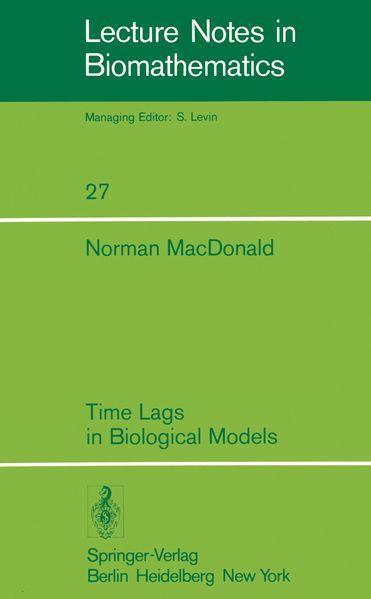
In many biological models it is necessary to allow the rates of change of the variables to depend on the past history, rather than only the current values, of the variables. The models may require discrete lags, with the use of delay-differential equations, or distributed lags, with the use of integro-differential equations. In these lecture notes I discuss the reasons for including lags, especially distributed lags, in biological models. These reasons may be inherent in the system studied, or may be the result of simplifying assumptions made in the model used. I examine some of the techniques available for studying the solution of the equations. A large proportion of the material presented relates to a special method that can be applied to a particular class of distributed lags. This method uses an extended set of ordinary differential equations. I examine the local stability of equilibrium points, and the existence and frequency of periodic solutions. I discuss the qualitative effects of lags, and how these differ according to the choice of discrete or distributed lag. The models studied are drawn from the population dynamiCS of single species (logistic growth, the chemostat) and of interacting pairs of species (predation, mutualism), from cell population dynamiCS (haemopoiesis) and from biochemical kinetics (the Goodwin oscillator). The last chapter is devoted to a population model employing difference equations. All these models include non-linear terms.
| Reihe | Lecture Notes in Biomathematics |
|---|---|
| Themen | Mathematik und Naturwissenschaften Mathematik |
| ISBN | 9783540090922 |
| Sprache | Englisch |
| Erscheinungsdatum | 05.11.1978 |
| Größe | 24.4 x 17 cm |
| Verlag | Springer Berlin |
| Lieferzeit | Lieferung in 7-14 Werktagen |
| Herstellerangaben | Anzeigen Springer Nature Customer Service Center GmbH Europaplatz 3 | DE-69115 Heidelberg ProductSafety@springernature.com |
Wie gefällt Ihnen unser Shop?