GUTSCHEIN
Bitte haben Sie einen Moment Geduld, wir legen Ihr Produkt in den Warenkorb.
Diese Produkte könnten Sie auch interessieren:
Auch verfügbar als:
Bitte haben Sie einen Moment Geduld, wir legen Ihr Produkt in den Warenkorb.
| Reihe | Springer Series in Solid-State Sciences |
|---|---|
| Themen | Technologie, Ingenieurswissenschaft, Landwirtschaft, Industrieprozesse Maschinenbau und Werkstoffe Materialwissenschaft Technische Anwendung von elektronischen, magnetischen, optischen Materialien |
| ISBN | 9783540212935 |
| Sprache | Englisch |
| Erscheinungsdatum | 22.06.2004 |
| Größe | 23.5 x 15.5 cm |
| Verlag | Springer Berlin |
| Lieferzeit | Lieferung in 7-14 Werktagen |
| Herstellerangaben | Anzeigen Springer Nature Customer Service Center GmbH Europaplatz 3 | DE-69115 Heidelberg ProductSafety@springernature.com |
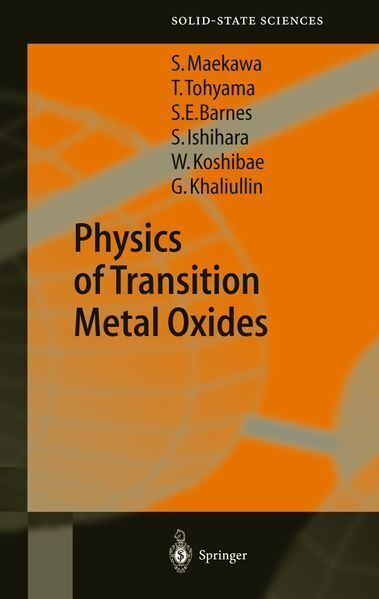
The fact that magnetite (Fe304) was already known in the Greek era as a peculiar mineral is indicative of the long history of transition metal oxides as useful materials. The discovery of high-temperature superconductivity in 1986 has renewed interest in transition metal oxides. High-temperature su perconductors are all cuprates. Why is it? To answer to this question, we must understand the electronic states in the cuprates. Transition metal oxides are also familiar as magnets. They might be found stuck on the door of your kitchen refrigerator. Magnetic materials are valuable not only as magnets but as electronics materials. Manganites have received special attention recently because of their extremely large magnetoresistance, an effect so large that it is called colossal magnetoresistance (CMR). What is the difference between high-temperature superconducting cuprates and CMR manganites? Elements with incomplete d shells in the periodic table are called tran sition elements. Among them, the following eight elements with the atomic numbers from 22 to 29, i. e. , Ti, V, Cr, Mn, Fe, Co, Ni and Cu are the most im portant. These elements make compounds with oxygen and present a variety of properties. High-temperature superconductivity and CMR are examples. Most of the textbooks on magnetism discuss the magnetic properties of transition metal oxides. However, when one studies magnetism using tradi tional textbooks, one finds that the transport properties are not introduced in the initial stages.
| Reihe | Springer Series in Solid-State Sciences |
|---|---|
| Themen | Technologie, Ingenieurswissenschaft, Landwirtschaft, Industrieprozesse Maschinenbau und Werkstoffe Materialwissenschaft Technische Anwendung von elektronischen, magnetischen, optischen Materialien |
| ISBN | 9783540212935 |
| Sprache | Englisch |
| Erscheinungsdatum | 22.06.2004 |
| Größe | 23.5 x 15.5 cm |
| Verlag | Springer Berlin |
| Lieferzeit | Lieferung in 7-14 Werktagen |
| Herstellerangaben | Anzeigen Springer Nature Customer Service Center GmbH Europaplatz 3 | DE-69115 Heidelberg ProductSafety@springernature.com |
Wie gefällt Ihnen unser Shop?