GUTSCHEIN
Bitte haben Sie einen Moment Geduld, wir legen Ihr Produkt in den Warenkorb.
Diese Produkte könnten Sie auch interessieren:
Bitte haben Sie einen Moment Geduld, wir legen Ihr Produkt in den Warenkorb.
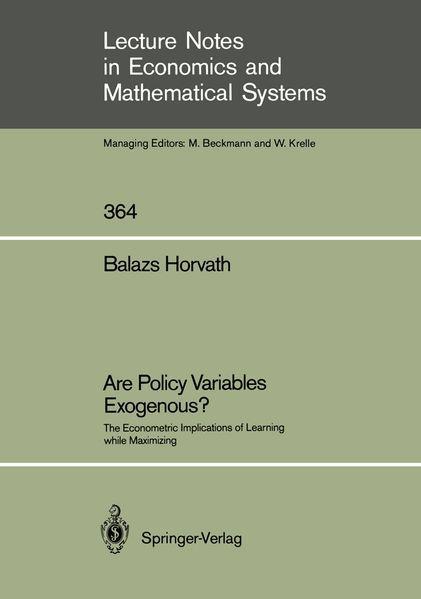
| Reihe | Lecture Notes in Economics and Mathematical Systems |
|---|---|
| Themen | Wirtschaftswissenschaft, Finanzen, Betriebswirtschaft und Management Wirtschaftswissenschaft Wirtschaftstheorie und -philosophie |
| ISBN | 9783540542872 |
| Sprache | Englisch |
| Erscheinungsdatum | 28.08.1991 |
| Größe | 24.2 x 17 cm |
| Verlag | Springer Berlin |
| Lieferzeit | Lieferung in 7-14 Werktagen |
| Herstellerangaben | Anzeigen Springer Nature Customer Service Center GmbH Europaplatz 3 | DE-69115 Heidelberg ProductSafety@springernature.com |
1. 1 Motivation and Definition of Topic To provide motivation and to help define the topic of this study, important links between specific areas of economic theory are first highlighted. (i) Learning and Rational Expectations Theory In a standard rational expectations setting, agents in equilibrium have all the information about the model that enables them to correctly forecast future payoff-relevant variables. What rational expectations theory in its standard form does not tell us is what happens outside a rational expectations equilibrium. Less than complete knowledge of the model is a possible way to represent a situation outside the rational expectations equilibrium. It is natural to assume that agents recognize error and optimally utilize all available external information to improve on their information level, i. e. learn. Based on the information acquired by learning they modify their behavior. Under certain conditions learning steers the economy to the rational expectations equilibrium (Spear (1989), Blume, Bray and Easley (1982), Townsend (1983». This literature shows that learning is a possible mechanism to acquire the necessary level of information that agents are assumed to possess in a rational expectations equilibrium and hence there is a clear link between rational expectations theory and the 2 theory of learning. This fact is also emphasized among others by Friedman (1975), Pesaran (1987) and DeCanio (1979). (ii) Rational Expectations and Econometrics The equilibrium consequences of the rational expectations hypothesis are discussed in a considerable body of literature - cf.
| Reihe | Lecture Notes in Economics and Mathematical Systems |
|---|---|
| Themen | Wirtschaftswissenschaft, Finanzen, Betriebswirtschaft und Management Wirtschaftswissenschaft Wirtschaftstheorie und -philosophie |
| ISBN | 9783540542872 |
| Sprache | Englisch |
| Erscheinungsdatum | 28.08.1991 |
| Größe | 24.2 x 17 cm |
| Verlag | Springer Berlin |
| Lieferzeit | Lieferung in 7-14 Werktagen |
| Herstellerangaben | Anzeigen Springer Nature Customer Service Center GmbH Europaplatz 3 | DE-69115 Heidelberg ProductSafety@springernature.com |
Wie gefällt Ihnen unser Shop?