GUTSCHEIN
Bitte haben Sie einen Moment Geduld, wir legen Ihr Produkt in den Warenkorb.
Diese Produkte könnten Sie auch interessieren:
Bitte haben Sie einen Moment Geduld, wir legen Ihr Produkt in den Warenkorb.
| Reihe | Lecture Notes in Economics and Mathematical Systems |
|---|---|
| Themen | Wirtschaftswissenschaft, Finanzen, Betriebswirtschaft und Management Wirtschaftswissenschaft Wirtschaftstheorie und -philosophie |
| ISBN | 9783540612797 |
| Sprache | Englisch |
| Erscheinungsdatum | 12.07.1996 |
| Größe | 29.7 x 21 cm |
| Verlag | Springer Berlin |
| Lieferzeit | Lieferung in 7-14 Werktagen |
| Herstellerangaben | Anzeigen Springer Nature Customer Service Center GmbH Europaplatz 3 | DE-69115 Heidelberg ProductSafety@springernature.com |
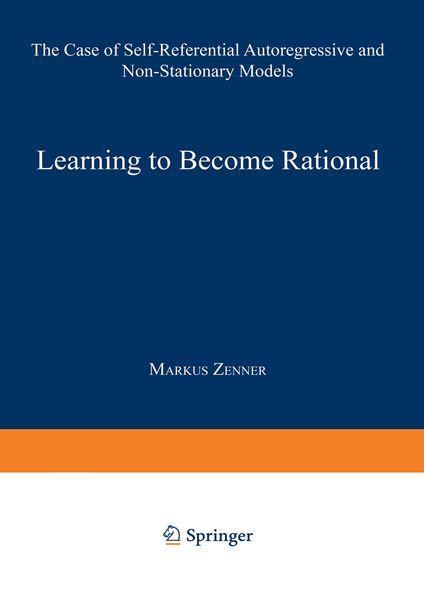
1. 1 Rational Expectations and Learning to Become Rational A characteristic feature of dynamic economic models is that, if future states of the economy are uncertain, the expectations of agents mat ter. Producers have to decide today which amount of a good they will produce not knowing what demand will be tomorrow. Consumers have to decide what they spend for consumption today not knowing what prices will prevail tomorrow. Adopting the neo-classical point of view that economic agents are 'rational' in the sense that they behave in their own best interest given their expectations about future states of the ecomomy it is usually assumed that agents are Bayesian deci sion makers. But, as LUCAS points out, there remains an element of indeterminacy: Unfortunately, the general hypothesis that economic agents are Bayesian decision makers has, in many applications, lit tle empirical content: without some way of infering what an agent's subjective view of the future is, this hypothesis is of no help in understanding his behavior. Even psychotic behavior can be (and today, is) understood as "rational", given a sufficiently abnormal view of relevant probabili ties. To practice economics, we need some way (short of psychoanalysis, one hopes) of understanding which decision problem agents are solving. (LucAs (1977, p. 15)) 2 CHAPTER 1. INTRODUCTION 1. 1.
| Reihe | Lecture Notes in Economics and Mathematical Systems |
|---|---|
| Themen | Wirtschaftswissenschaft, Finanzen, Betriebswirtschaft und Management Wirtschaftswissenschaft Wirtschaftstheorie und -philosophie |
| ISBN | 9783540612797 |
| Sprache | Englisch |
| Erscheinungsdatum | 12.07.1996 |
| Größe | 29.7 x 21 cm |
| Verlag | Springer Berlin |
| Lieferzeit | Lieferung in 7-14 Werktagen |
| Herstellerangaben | Anzeigen Springer Nature Customer Service Center GmbH Europaplatz 3 | DE-69115 Heidelberg ProductSafety@springernature.com |
Wie gefällt Ihnen unser Shop?