GUTSCHEIN
Bitte haben Sie einen Moment Geduld, wir legen Ihr Produkt in den Warenkorb.
Diese Produkte könnten Sie auch interessieren:
Bitte haben Sie einen Moment Geduld, wir legen Ihr Produkt in den Warenkorb.
| Reihe | Lecture Notes in Computer Science |
|---|---|
| Themen | Informatik und Informationstechnologie Informatik Künstliche Intelligenz (KI) Maschinelles Sehen, Bildverstehen |
| ISBN | 9783540710264 |
| Sprache | Englisch |
| Erscheinungsdatum | 09.02.2007 |
| Größe | 23.5 x 15.5 cm |
| Verlag | Springer Berlin |
| Herausgegeben von | Pierre P Lévy, Bénédicte Le Grand, François Poulet, Michel Soto, Laszlo Darago, Laurent Toubiana, Jean-Francois Vibert |
| Lieferzeit | Lieferung in 7-14 Werktagen |
| Herstellerangaben | Anzeigen Springer Nature Customer Service Center GmbH Europaplatz 3 | DE-69115 Heidelberg ProductSafety@springernature.com |
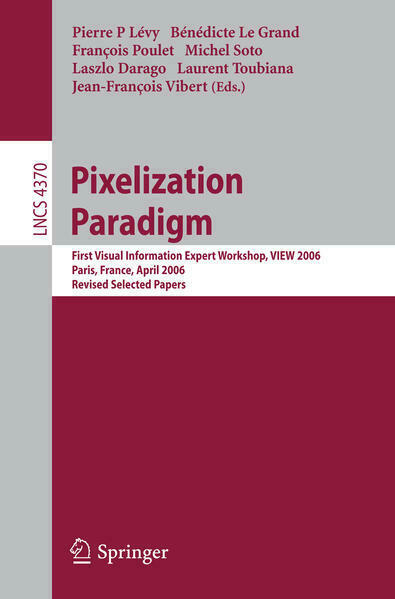
The pixelization paradigm states as a postulate that pixelization methods are rich and are worth exploring as far as possible. In fact, we think that the strength of these methods lies in their simplicity, in their high-density way of information representation property and in their compatibility with neurocognitive processes. • Simplicity, because pixelization belongs to two-dimensional information visualization methods and its main idea is identifying a “pixel” with an informational entity in order to translate a set of informational entities into an image. • High-density way of information representation property, firstly because pixelization representation contains a third dimension—each pixel’s color—and secondly because pixelization is a “compact” (two-dimensional) way of representing information compared with linear one-dimensional representations (Ganascia, p.255) . • Compatibility with neurocognitive processes, firstly because we are thr- dimensional beings and thus we are intrinsically better at grasping one- or two-dimensional data, and secondly because the cerebral cortex is typically a bi-dimensional structure where metaphorically the neurons can be assimilated to “pixels,” whose activity plays the role of color (Lévy, p.3). The pixelization paradigm may be studied along two related directions: pixelization and its implementation and pixelization and cognition. The first direction—pixelization and its implementation—may be divided into two parts: pixelization theory and pixelization application.
| Reihe | Lecture Notes in Computer Science |
|---|---|
| Themen | Informatik und Informationstechnologie Informatik Künstliche Intelligenz (KI) Maschinelles Sehen, Bildverstehen |
| ISBN | 9783540710264 |
| Sprache | Englisch |
| Erscheinungsdatum | 09.02.2007 |
| Größe | 23.5 x 15.5 cm |
| Verlag | Springer Berlin |
| Herausgegeben von | Pierre P Lévy, Bénédicte Le Grand, François Poulet, Michel Soto, Laszlo Darago, Laurent Toubiana, Jean-Francois Vibert |
| Lieferzeit | Lieferung in 7-14 Werktagen |
| Herstellerangaben | Anzeigen Springer Nature Customer Service Center GmbH Europaplatz 3 | DE-69115 Heidelberg ProductSafety@springernature.com |
Wie gefällt Ihnen unser Shop?