GUTSCHEIN
Bitte haben Sie einen Moment Geduld, wir legen Ihr Produkt in den Warenkorb.
Diese Produkte könnten Sie auch interessieren:
Bitte haben Sie einen Moment Geduld, wir legen Ihr Produkt in den Warenkorb.
| Reihe | Progress in Molecular and Subcellular Biology |
|---|---|
| Themen | Medizin Klinische und Innere Medizin Krankheiten und Störungen Onkologie |
| ISBN | 9783642636592 |
| Sprache | Englisch |
| Erscheinungsdatum | 08.10.2012 |
| Größe | 235 x 155 mm |
| Verlag | Springer |
| Herausgegeben von | Philippe Jeanteur |
| Lieferzeit | Lieferung in 7-14 Werktagen |
| Herstellerangaben | Anzeigen Europaplatz 3 | DE-69115 Heidelberg ProductSafety@springernature.com |
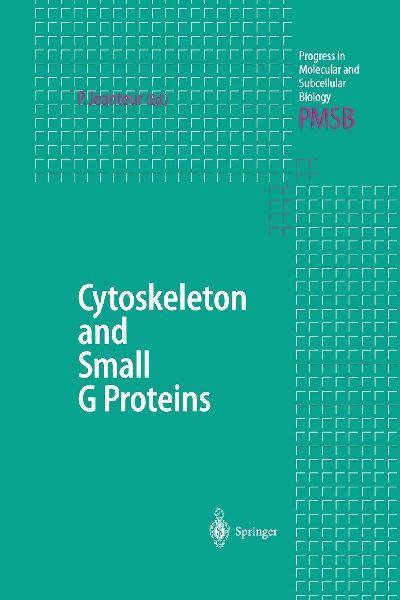
Animal cells present an extreme variability in their shapes in relation to their physiological properties. For instance, fibroblastic cells are tightly attached to the extra-cellular matrix and display a flattened, spindle-shaped morphology. Neuronal cells self-organize as a network through a complex branching of dendrites and a long axonal extension. Resting peripheral blood lymphocytes are poorly adhesive and maintain a spherical, smooth shape, while macroph ages produce many pseudopodal extensions involved in the recognition of foreign molecules. In addition to the variability of the morphology of the cells that constitute different organs, many cell types also modify dynamically their morphology in response to environmental changes, leading to differential cell motility, migration, adhesion, polarity or intercellular contacts. This wide plasticity of cell morphology is promoted and maintained by the cytoskeleton, which is composed of the three interconnected actin micro filaments, tubulin microtubules and intermediate filaments networks, all capable of assembly and disassembly. Over the past few years, the Rho family of Ras-like GTPases emerged as key proteins that mediate extracellular signalling pathways leading to the forma tion of polymerized actin-containing structures such as ruffles, lamellipodia and filopodia. Since the discovery of the first member RhoA in 1985, 13 mem bers have so far been characterized in human cells. Most of Rho proteins are highly conserved between species as distant as yeast, slime mold, insects and mammals, which points to their fundamental role in cellular physiology.
| Reihe | Progress in Molecular and Subcellular Biology |
|---|---|
| Themen | Medizin Klinische und Innere Medizin Krankheiten und Störungen Onkologie |
| ISBN | 9783642636592 |
| Sprache | Englisch |
| Erscheinungsdatum | 08.10.2012 |
| Größe | 235 x 155 mm |
| Verlag | Springer |
| Herausgegeben von | Philippe Jeanteur |
| Lieferzeit | Lieferung in 7-14 Werktagen |
| Herstellerangaben | Anzeigen Europaplatz 3 | DE-69115 Heidelberg ProductSafety@springernature.com |
Wie gefällt Ihnen unser Shop?