GUTSCHEIN
Bitte haben Sie einen Moment Geduld, wir legen Ihr Produkt in den Warenkorb.
Diese Produkte könnten Sie auch interessieren:
Bitte haben Sie einen Moment Geduld, wir legen Ihr Produkt in den Warenkorb.
| Reihe | Progress in Molecular and Subcellular Biology |
|---|---|
| Themen | Mathematik und Naturwissenschaften Biologie, Biowissenschaften Zellbiologie (Zytologie) |
| ISBN | 9783642644207 |
| Sprache | Englisch |
| Erscheinungsdatum | 18.09.2011 |
| Größe | 23.5 x 15.5 cm |
| Verlag | Springer Berlin |
| Herausgegeben von | Philippe Jeanteur |
| Lieferzeit | Lieferung in 7-14 Werktagen |
| Herstellerangaben | Anzeigen Springer Nature Customer Service Center GmbH Europaplatz 3 | DE-69115 Heidelberg ProductSafety@springernature.com |
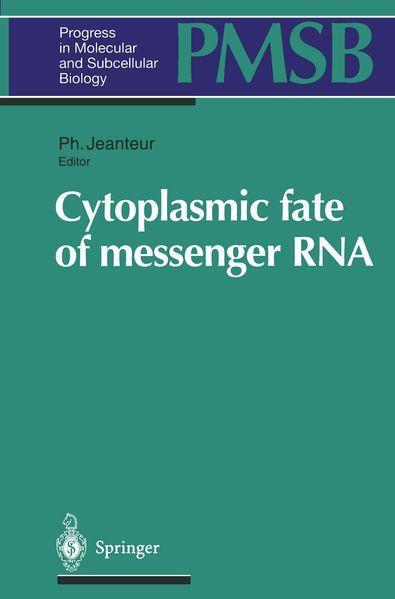
Among all cellular RNA species of the three main types, ribosomal RNA, transfer RNA or messenger RNA, be they from prokaryotic or eukaryotic organisms, the prokaryotic mRNA is unique in that it has no precursor and is synthesized in the same mature form as it is translated into proteins. In fact, ribosomes join the nascent mRNA chain and engage in protein synthesis long before its transcription is complete. Provisions are even made for slowing down the ribo somes at some sites to prevent them from catching up with the RNA-polymerase. Of course, such a situation is only possible in the prokaryotic world where there is no such thing as a nuclear mem brane physically secluding the transcription process from the cy toplasm where translation is restricted. Quite in the opposite extreme, the eukaryotic pre-messenger RNA has to suffer many and sometimes drastic steps of maturation (capping, polyadenylation, splicing, edition) before the decision is made to export it to the cytoplasm. That is where it enters the scope of this book. Once in the cytoplasm, many options are still open to it: its entrance into polysomes may be delayed (as it is in unfertilized eggs) or merely prohibited (ferritin mRNA in iron-starved cells), directed to specific locations within the cytoplasm or be more or less rapidly degraded. During gametogenesis and early development, translational control is probably the most significant level of gene expression.
| Reihe | Progress in Molecular and Subcellular Biology |
|---|---|
| Themen | Mathematik und Naturwissenschaften Biologie, Biowissenschaften Zellbiologie (Zytologie) |
| ISBN | 9783642644207 |
| Sprache | Englisch |
| Erscheinungsdatum | 18.09.2011 |
| Größe | 23.5 x 15.5 cm |
| Verlag | Springer Berlin |
| Herausgegeben von | Philippe Jeanteur |
| Lieferzeit | Lieferung in 7-14 Werktagen |
| Herstellerangaben | Anzeigen Springer Nature Customer Service Center GmbH Europaplatz 3 | DE-69115 Heidelberg ProductSafety@springernature.com |
Wie gefällt Ihnen unser Shop?