Bitte haben Sie einen Moment Geduld, wir legen Ihr Produkt in den Warenkorb.
Diese Produkte könnten Sie auch interessieren:
Bitte haben Sie einen Moment Geduld, wir legen Ihr Produkt in den Warenkorb.
| Reihe | Hochschulschriften |
|---|---|
| ISBN | 9783731612025 |
| Sprache | Englisch |
| Erscheinungsdatum | 01.04.2016 |
| Genre | Wirtschaft/Volkswirtschaft |
| Verlag | Metropolis |
| Lieferzeit | Lieferung in 7-14 Werktagen |
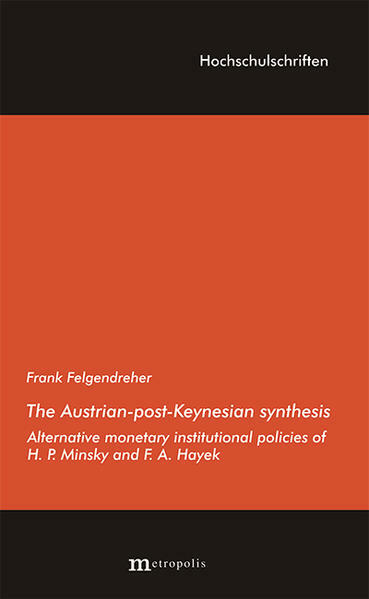
This book is inspired by the financial crisis of 2008 and concentrates on two alternative theories, which both assume an inherent financial instability in a capitalistic economy. On the one hand there is the financial instability hypothesis by Hyman P. Minsky and on the other hand there is the business cycle theory by Friedrich A. Hayek.
Whereas the strength of Minsky is the insight into the workings of financial markets and thereby the importance of liquidity preference, the strength of Hayek rests with the understanding of the misallocation of resources. It is shown that the improvements in Hayek's theory which were induced through post-Keynesian critique are the ones which render an Austrian-post-Keynesian synthesis to be possible. The Austrian-post-Keynesian synthesis thereby uses the strengths of the two respective theories to compensate their respective weaknesses. This synthesis therefore incorporates expectations through the expected internal rate of interest as well as liquidity preference from the Minsky world. Furthermore it adopts from Minsky's theory the crucial element of innovation. Hayek's world on the other hand contributes the fact that capital is heterogeneous as well as the roundaboutness of production and with it the importance of an inter-temporal scarcity of resources.
In this context it is shown that not every credit money creation, which induces investment that exceeds prior saving, may lead automatically to a crisis, but that this very much depends upon the force of innovation that this investment is able to unleash. It therefore depends on the quality of the investment to instantly increase the productivity of an economy by amending its production function. For choosing an adequate financial architecture this would mean that credit money creation should not be condemned completely as also its force of innovation may thereby be discarded with it. However, excesses should be prevented through currency competition in the sense of a fractional reserve free-banking system. In order to ensure a stable payment system this would, however, also require a central bank, because a fractional reserve free-banking system on its own cannot be entirely free from the risk of causing a liquidity crisis.
| Reihe | Hochschulschriften |
|---|---|
| ISBN | 9783731612025 |
| Sprache | Englisch |
| Erscheinungsdatum | 01.04.2016 |
| Genre | Wirtschaft/Volkswirtschaft |
| Verlag | Metropolis |
| Lieferzeit | Lieferung in 7-14 Werktagen |
Wie gefällt Ihnen unser Shop?