Bitte haben Sie einen Moment Geduld, wir legen Ihr Produkt in den Warenkorb.
Diese Produkte könnten Sie auch interessieren:
Bitte haben Sie einen Moment Geduld, wir legen Ihr Produkt in den Warenkorb.
| Reihe | Hochschulschriften |
|---|---|
| ISBN | 9783731615200 |
| Sprache | Englisch |
| Erscheinungsdatum | 12.09.2022 |
| Genre | Wirtschaft/Volkswirtschaft |
| Verlag | Metropolis |
| Lieferzeit | Lieferung in 7-14 Werktagen |
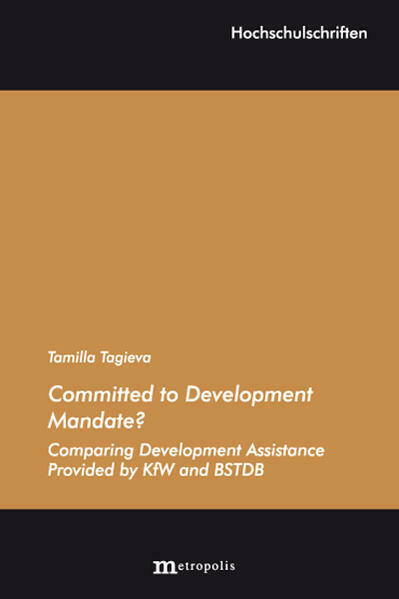
Existing literature on development banks points to the politicized character of their lending programs as one of the reasons for the ineffectiveness of development finance. Whether lending provided by donor-dominated KfW, a German government-owned development bank, and borrowing countriesled BSTDB is contingent upon political factors is the main point of discussion in this research work. By applying mostly qualitative methods along with statistical data, this study shows that with its international concessional finance the German government has attempted to promote the European Union’s
geopolitical ambitions in South Caucasus, which is related to connecting Georgia and Armenia (as well as their neighboring countries) with European Union’s single energy market and thereby securing the electricity supplies for the EU. Evidence also suggests that DEG, KfW’s hard loan window, deviates from its development mandate by pursuing
profit-maximizing strategies. The reputation of this financial institution has been seriously impaired due to numerous cases of human rights violations associated with DEG financing and the institution’s involvement with offshore centers. In contrast to KfW, BSTDB’s working approach seems to be rather developmentoriented, although the bank lacks decisionmaking
autonomy due to the pressure exerted by credit rating agencies and the global system of development banks. The
bank does not lose sight of the qualitative dimension of its lending programs. In its energy policy, it is stated that BSTDB does not attach conditionalities to its loan programs and that it does not promote privatization or any one model of energy sector reform. Evidence shows that BSTDB positively views the TANAP pipeline – a European Union project, which is not desired by Russia, one of BSTDB’s major shareholders. This may speak for Russia’s limited ability to exert influence upon the bank.
| Reihe | Hochschulschriften |
|---|---|
| ISBN | 9783731615200 |
| Sprache | Englisch |
| Erscheinungsdatum | 12.09.2022 |
| Genre | Wirtschaft/Volkswirtschaft |
| Verlag | Metropolis |
| Lieferzeit | Lieferung in 7-14 Werktagen |
Wie gefällt Ihnen unser Shop?