GUTSCHEIN
Bitte haben Sie einen Moment Geduld, wir legen Ihr Produkt in den Warenkorb.
Diese Produkte könnten Sie auch interessieren:
Bitte haben Sie einen Moment Geduld, wir legen Ihr Produkt in den Warenkorb.
| Reihe | Schriftenreihe Institut für Dynamik und Schwingungen TU Braunschweig |
|---|---|
| Themen | Technologie, Ingenieurswissenschaft, Landwirtschaft, Industrieprozesse Verkehrstechnik und Transportwesen Fahrzeugbau |
| ISBN | 9783819105913 |
| Sprache | Deutsch |
| Erscheinungsdatum | 24.04.2026 |
| Größe | 21 x 14.8 cm |
| Verlag | Shaker |
| Lieferzeit | Lieferung in 7-14 Werktagen |
| Herstellerangaben | Anzeigen Shaker Verlag GmbH Am Langen Graben 15a | DE-52353 Düren info@shaker.de |
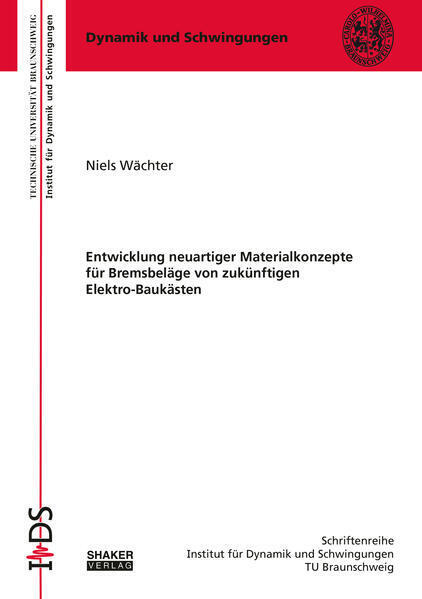
The brake pad is a crucial part of the brake and together with its friction couple, mostly, dictates the brake’s characteristics. Nowadays, brakes shall be, among other requirements, performant, simultaneously NVH-optimized, durable, inexpensive and environmentally friendly. The task of the friction couple is to unify these partly contradicting requirements. But the friction material often is considered as a black-box as it is a multi-substance mixture with dozens of raw materials. Interactions between those ingredients and their effect on the required properties are not fully understood. It is expected that there will be a shift in brake (pad) requirements for future vehicle concepts. Electrification, autonomous driving, digitalization and environmental requirements bring new brake (pad) requirements already today. Friction stability, corrosion and particle emissions are just a few of the new emerging demands. How can requirements specifically for future mobility be covered by suitable brake pad material concepts? In this study, first, a comprehensive overview of future mobility is presented and future requirements are derived with a top-down approach. Coming from general vehicle requirements of future mobility concepts, friction couple requirements are deducted and a set of targeted prioritized properties is discussed. In cooperation with suppliers, raw material classes are categorized with regard to which properties they cause in the brake pad. Additionally, test specifications are re-designed towards the found new mobility scenarios. The desired prioritized target properties are then tested prototypically for their fulfillment.
| Reihe | Schriftenreihe Institut für Dynamik und Schwingungen TU Braunschweig |
|---|---|
| Themen | Technologie, Ingenieurswissenschaft, Landwirtschaft, Industrieprozesse Verkehrstechnik und Transportwesen Fahrzeugbau |
| ISBN | 9783819105913 |
| Sprache | Deutsch |
| Erscheinungsdatum | 24.04.2026 |
| Größe | 21 x 14.8 cm |
| Verlag | Shaker |
| Lieferzeit | Lieferung in 7-14 Werktagen |
| Herstellerangaben | Anzeigen Shaker Verlag GmbH Am Langen Graben 15a | DE-52353 Düren info@shaker.de |
Wie gefällt Ihnen unser Shop?