GUTSCHEIN
Bitte haben Sie einen Moment Geduld, wir legen Ihr Produkt in den Warenkorb.
Diese Produkte könnten Sie auch interessieren:
Bitte haben Sie einen Moment Geduld, wir legen Ihr Produkt in den Warenkorb.
| Reihe | Human Data Understanding - Sensors, Models, Knowledge |
|---|---|
| Themen | Informatik und Informationstechnologie |
| ISBN | 9783832558512 |
| Sprache | Englisch |
| Erscheinungsdatum | 08.10.2024 |
| Größe | 24 x 17 cm |
| Verlag | Logos Berlin |
| Lieferzeit | Lieferung in 7-14 Werktagen |
| Herstellerangaben | Anzeigen Logos Verlag Berlin GmbH Georg-Knorr-Str. 4, Geb. 10 | DE-12681 Berlin redaktion@logos-verlag.de |
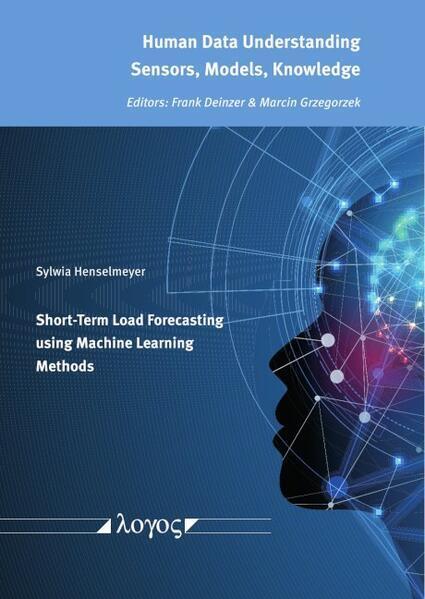
Maintaining the balance between generation and consumption is at the heart of electricity grid operation. A disruption to this balance can lead to grid overloads, outages, system damage, rising electricity costs or wasted electricity. For this reason, accurate forecasting of load behavior is crucial. In this work, two classes of ML-based algorithms were used for load forecasting: the Hidden Markov Models (HMMs) and the Deep Neural Networks (DNNs), both of which provide stable and more accurate results than the considered benchmark methods. HMMs could be successfully used as a stand-alone predictor with a training based on Maximum Likelihood Estimation (MLE) in combination with a clustering of the training data and an optimized Viterbi algorithm, which are the main differences to other HMM-related load forecasting approaches in the literature. Adaptive online training was developed for DNNs to minimize training times and create forecasting models that can be deployed faster and updated as often as necessary to account for the increasing dynamics in power grids related to the growing share of installed renewables. In addition, the flexible and powerful encoder-decoder architecture was used, which helped to minimize the forecast error compared to simpler DNN architectures such as Convolutional Neural Networks (CNNs), Recurrent Neural Networks (RNNs), Long Short-Term Memory networks (LSTMs) and others.
| Reihe | Human Data Understanding - Sensors, Models, Knowledge |
|---|---|
| Themen | Informatik und Informationstechnologie |
| ISBN | 9783832558512 |
| Sprache | Englisch |
| Erscheinungsdatum | 08.10.2024 |
| Größe | 24 x 17 cm |
| Verlag | Logos Berlin |
| Lieferzeit | Lieferung in 7-14 Werktagen |
| Herstellerangaben | Anzeigen Logos Verlag Berlin GmbH Georg-Knorr-Str. 4, Geb. 10 | DE-12681 Berlin redaktion@logos-verlag.de |
Wie gefällt Ihnen unser Shop?