Bitte haben Sie einen Moment Geduld, wir legen Ihr Produkt in den Warenkorb.
Diese Produkte könnten Sie auch interessieren:
Bitte haben Sie einen Moment Geduld, wir legen Ihr Produkt in den Warenkorb.
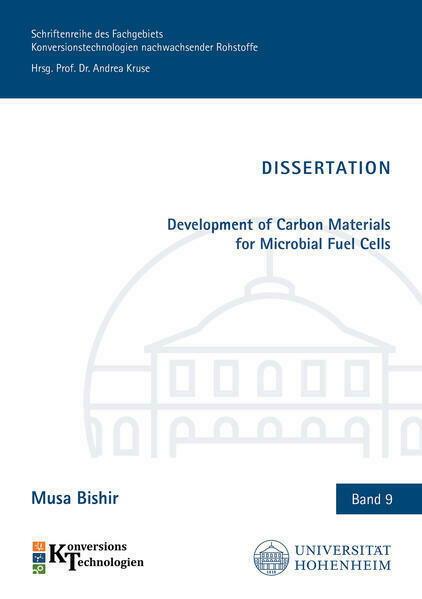
| Reihe | Schriftenreihe des Fachgebiets Konversionstechnologien nachwachsender Rohstoffe |
|---|---|
| ISBN | 9783844088151 |
| Sprache | Englisch |
| Erscheinungsdatum | 17.11.2022 |
| Genre | Biologie/Biochemie, Biophysik |
| Verlag | Shaker |
| Lieferzeit | Lieferung in 7-14 Werktagen |
Microbial fuel cell (MFC) is an evolving technology for anaerobic bioenergy generation using electrodes and organic wastewater as a feedstock for catabolic activities of electrogenic bacteria with subsequent electricity generation. There are growing interests in microbial fuel cells (MFCs) for anaerobic bioenergy generation. Researchers in this discipline continue to be most interested in finding suitably affordable electrode materials. However, despite the large varieties of commercially available electrodes, only few are suitable for electro-active bacterial colonization, during biofilm formation in MFCs, and most of these electrodes are cost prohibitive. Hence there is need to search for low-cost alternative electrodes for MFCs. The focus of this study was to develop electrodes locally from corncob biomass for application in microbial fuel cells. Pyrochars were produced by pyrolysis and subsequently activated with steam or potassium hydroxide (KOH). A comparative bioelectricity generation from process water of hydrothermal carbonization of spent bear grains and treated–biogas digestate, was carried out in dual-chambered MFCs, using graphite rod and the locally developed potassium hydroxide–activated corncob pyrochar (KAC) and steam- activated corncob pyrochar electrodes. A standard strain of actively dividing cells of the electroactive bacterium Shewanella oneidensis MR-1, was used as inoculum for bioelectricity generation. Conclusively, the chemical activation of the pyrochar with KOH resulted in increased electrical conductivity, pore diameter, and most importantly the material’s surface area and a highest Coulombic efficiency of 75 % was recorded from the MFC operated with treated biogas digestate and KAC electrode in a shorter residence time.
| Reihe | Schriftenreihe des Fachgebiets Konversionstechnologien nachwachsender Rohstoffe |
|---|---|
| ISBN | 9783844088151 |
| Sprache | Englisch |
| Erscheinungsdatum | 17.11.2022 |
| Genre | Biologie/Biochemie, Biophysik |
| Verlag | Shaker |
| Lieferzeit | Lieferung in 7-14 Werktagen |
Wie gefällt Ihnen unser Shop?