GUTSCHEIN
Bitte haben Sie einen Moment Geduld, wir legen Ihr Produkt in den Warenkorb.
Diese Produkte könnten Sie auch interessieren:
Bitte haben Sie einen Moment Geduld, wir legen Ihr Produkt in den Warenkorb.
| Reihe | BAC - Bochumer Altertumswissenschaftliches Colloquium |
|---|---|
| Themen | Biographie, Literatur und Literaturwissenschaft Geschichte und Kritik Vergleichende Literaturwissenschaft |
| ISBN | 9783868219456 |
| Sprache | Englisch, Deutsch |
| Erscheinungsdatum | 19.04.2022 |
| Größe | 219 x 152 cm |
| Verlag | WVT Wissenschaftlicher Verlag Trier |
| Herausgegeben von | Manuel Baumbach |
| Lieferzeit | Lieferung in 7-14 Werktagen |
| Herstellerangaben | Anzeigen Wissenschaftlicher Verlag Trier Bergstr. 27 | DE-54295 Trier wvt@wvttrier.de |
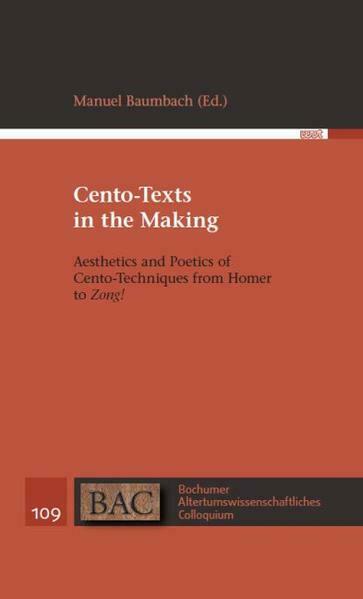
Cento-texts represent an extreme case of intertextuality. In gathering material from different sources and weaving it together they form a patchwork, which is in constant dialogue with the literary tradition. The different components can take on new meanings and, at the same time, refer back to their original contexts. This interdisciplinary volume explores different cento-techniques from Antiquity to the present day. It focusses upon poetological reflections, which are often linked with or even inscribed in the usage of cento-techniques, and it takes into account varied understandings of cento-writings in the history of reception. The contributions compare different cultural traditions and approach cento-techniques from an aesthetical point of view. They examine questions of authorship, authorization and fragmentarization. They ask which metaphors or concepts are used to describe cento-techniques (e.g. bees, weaving, hooking, bricolage), and they discuss the poiesis of cento-texts in the Aristotelian sense of ‘being made‘. The arrangement of the contributions in this volume is centonic insofar they are neither ordered chronologically nor according to specific topics. Rather, they form a patchwork, which invites the reader to compare different methodological approaches of dealing with cento-texts from Homer to Zong!Table of Contents MANUEL BAUMBACH Selecting, Cutting and Weaving Texts: The Poiesis of Cento-Writings ...................... 9 ROWENA FOWLER Ezra Pound’s Rag-Bag: The Cantos as Cento ........................................................... 21 TIMO CHRISTIAN Homerische Glossen und Rezeptionsniveaus in den Homerocentones ...................... 41 JULIA HEIDEKLANGHos Centones : Otto Brunfels’ Herbarum vivae eicones (1530) and Contrafayt Krëutterbuch (1532) ......................................................................... 63 MALI SKOTHEIM Reading Environmental Devastation through Vergil’s Eclogues in 18th-Century Mexico: Don Bruno Francisco Larrañaga’s La America Socorrida (1786) ............... 89 Johanna-Charlotte Horst “I prefer not to... say it myself”: On Georges Perec’s Composite WorkUn homme qui dort .................................................................................................. 103 LINDA SIMONIS Cento Techniques in Pierre de Ronsard’s Franciad ................................................ 115 SALLY BAUMANN, LUKAS SPIELHOFER Intertextual and Metapoetic Aspects in Ausoniusʼs Cento nuptialis (Cent. nupt. 12-32; 57-66) ....................................................................................... 135 MAURICE PARUSSEL Ein Cento im intertextuellen Gewebe: Zur Schreibweise des Reisebriefes Konrads von Querfurt .............................................................................................. 157 MARK A. MCCUTCHEON Paratextual and “Sampladelic” Techniques for “Committing Centonism” in Contemporary Poetry Published in Canada ......................................................... 175 SINA DELL’ANNO „Der Philolog redet nicht selbst“ – Zur Cento-Technik Johann Georg Hamanns .... 201 MORITZ RAUCHHAUS Unity through Intertextuality: The Portrayal of Giovanni da Procida in the Cento-Novel Aventuroso Ciciliano (ca. 1333) ............................................... 219 MARIA TERESA GALLI Cento Technique in Lelio Capilupi’s Patchwork Poem for Cristoforo Madruzzo ... 231 EMANUELA FERRAGAMO Morgensterns Cento: Eine Analyse des Essays Nietzsche, der Erzieher (1896) ...... 241 JODOK TRÖSCH Cento, Quodlibet, or Compilation? Combinatorial Techniques of Citation in Fischart’s Geschichtklitterung ................ 265 List of Contributors ................................................................................................. 291
| Reihe | BAC - Bochumer Altertumswissenschaftliches Colloquium |
|---|---|
| Themen | Biographie, Literatur und Literaturwissenschaft Geschichte und Kritik Vergleichende Literaturwissenschaft |
| ISBN | 9783868219456 |
| Sprache | Englisch, Deutsch |
| Erscheinungsdatum | 19.04.2022 |
| Größe | 219 x 152 cm |
| Verlag | WVT Wissenschaftlicher Verlag Trier |
| Herausgegeben von | Manuel Baumbach |
| Lieferzeit | Lieferung in 7-14 Werktagen |
| Herstellerangaben | Anzeigen Wissenschaftlicher Verlag Trier Bergstr. 27 | DE-54295 Trier wvt@wvttrier.de |
Wie gefällt Ihnen unser Shop?