GUTSCHEIN
Bitte haben Sie einen Moment Geduld, wir legen Ihr Produkt in den Warenkorb.
Diese Produkte könnten Sie auch interessieren:
Bitte haben Sie einen Moment Geduld, wir legen Ihr Produkt in den Warenkorb.
| Reihe | LuKA - Studien zu Literaturen und Kunst Afrikas |
|---|---|
| ISBN | 9783868219753 |
| Sprache | Englisch |
| Erscheinungsdatum | 15.06.2023 |
| Genre | Sprachwissenschaft, Literaturwissenschaft/Englische Sprachwissenschaft, Literaturwissenschaft |
| Verlag | WVT Wissenschaftlicher Verlag Trier |
| Lieferzeit | Lieferung in 7-14 Werktagen |
| Herstellerangaben | Anzeigen Wissenschaftlicher Verlag Trier Bergstr. 27 | DE-54295 Trier wvt@wvttrier.de |
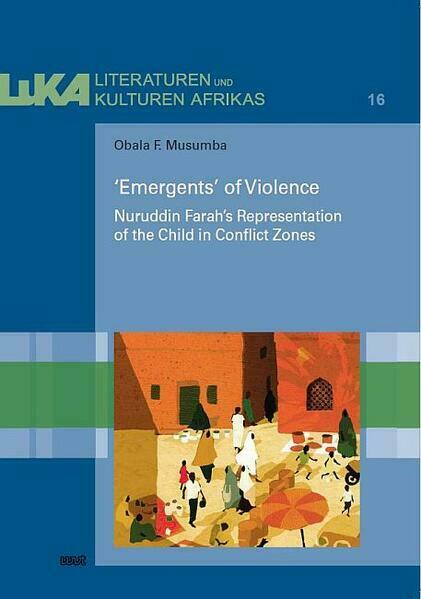
This book critically analyses the representation of the child character in Nuruddin Farah’s Past Imperfect trilogy which consists of the novels Links, Knots and Crossbones. The book focuses on Farah’s fictionalization of the child character in a violent Somalia by highlighting the nexus between violence, childhood and the postcolonial nation as represented in Farah’s art of novel writing. By reading the current state of a split-up Somalia through postcolonial lenses, the child is being centred as a symbol for entangled conflicts, identity constructions and projections into future. The book also engages selected novels by a younger generation of authors illuminating the plight of the child subject in times of war in Eastern African states such as Somalia, Kenya, Rwanda, Uganda, and Burundi. It reveals that the violent conflicts experienced in this region mediate the emergence of an ambivalent child of violence; a child who bears the brunt of violence and also unleashes violence upon the society. This child of violence is thus critical in defining the kind of society that is responsible for her/his emergence. S/he portends a unique form of hopelessness in the society and by contrast also as a ray of hope for the reconstruction of a new state that would be free of violence and that appeals to everyone.
Obala F. Musumba holds a PhD degree from the Institute of Asian and African Studies, Humboldt University of Berlin. Currently, he is a lecturer of Comparative Literature at Bomet University College in Kenya.
Contents
Acknowledgements xi
Introduction 1
Part I: Theoretical and Contextual Preliminaries 7
1. The Somali Worldview 7
1.1 Political and Cultural Liminality in Somalia 7
1.2 Somali Orality 14
1.3 Somali in the Islamic Purview 16
1.4 Being a Somali Child 20
2. Theorising and Narrating Violence in Postcolonial Africa 27
2.1 Postcolonial Theory 28
2.2 Rooting Postcolonial Violence in Colonialism 30
2.3 Traumatic Aftermath 44
2.4 A Narratological Reading of the Past Imperfect Trilogy 48
3. Nuruddin Farah: Chronicling Somalia’s Politics through Fiction 52
3.1 Nuruddin Farah 53
3.2 The Art of Trilogy Writing 57
3.3 Overviews, Childhood and Violence in the Past Imperfect Trilogy 66
3.4 A Fourth Trilogy? New Identities and Displacement in Hiding in Plain Sight and North of Dawn 71
Part II: Forms and Functions of Children of the Somali Conflict Zone(s) in Nuruddin Farah’s Past Imperfect Trilogy 78
4. The Child Character in the Interstices of Public and Private Space in the Past Imperfect Trilogy 78
4.1 The Dialectics of Peace in the Time of War 78
4.2 Idyllic Symbol(s) and Representations 86
5. The Flight Motif in the Past Imperfect Trilogy 95
5.1 Martyrdom in Islam 97
5.2 Dying in Order to Live: The Ambiguity of Death in Islam 99
5.3 Mitigating Factors for Flight 100
5.4 Linguistic Mapping of Zones of Contests 107
5.5 Beyond the Horizons of Diaspora in Crossbones 109
6. The Dilemma of the Child Character in the Past Imperfect Trilogy 114
6.1 Childhood at Risk 115
6.2 Mediating Spaces between Clan, Nationality, and Globality 117
6.3 In the Midway of Returning and Staying 121
7. Narrating the Child and Farah’s Critical Social Vision 125
7.1 Retelling the War Narrative 126
7.2 Evaluating Farah’s Critical Social Vision 131
Part III: Comparative Readings: Children in Diasporic Somali and Eastern African Literatures 139
8. Nuruddin Farah and Contemporary Somali Diaspora Novel 139
8.1 Somali Literature: Transitioning from Orality to Written Literature 140
8.2 Entanglement of Migration, Identity, and Trauma in the Contemporary Somali Novel 145
8.3 Transcending Borders in Black Mamba Boy 148
8.4 A Traumatic Cartography of the Nation in The Orchard of Lost Souls 154
8.5 Re-discovering the Self in Adua 158
9. Re-Situating the Child Figure in Zones of Violence in the Eastern African Novel 165
9.1 Breaking the Vicious Cycle of Ethnic Hatred in The Last Villains of Molo 168
9.2 A Fabled ‘Happily Ever After’ in Weep Not, Refugee 171
9.3 Domesticating a National Violence in Waiting: a Novel of Uganda at War 175
9.4 The Oldest Orphan: Re-writing the Rwanda Genocide 178
Conclusion 184
References 189
| Reihe | LuKA - Studien zu Literaturen und Kunst Afrikas |
|---|---|
| ISBN | 9783868219753 |
| Sprache | Englisch |
| Erscheinungsdatum | 15.06.2023 |
| Genre | Sprachwissenschaft, Literaturwissenschaft/Englische Sprachwissenschaft, Literaturwissenschaft |
| Verlag | WVT Wissenschaftlicher Verlag Trier |
| Lieferzeit | Lieferung in 7-14 Werktagen |
| Herstellerangaben | Anzeigen Wissenschaftlicher Verlag Trier Bergstr. 27 | DE-54295 Trier wvt@wvttrier.de |
Wie gefällt Ihnen unser Shop?