GUTSCHEIN
Bitte haben Sie einen Moment Geduld, wir legen Ihr Produkt in den Warenkorb.
Diese Produkte könnten Sie auch interessieren:
Bitte haben Sie einen Moment Geduld, wir legen Ihr Produkt in den Warenkorb.
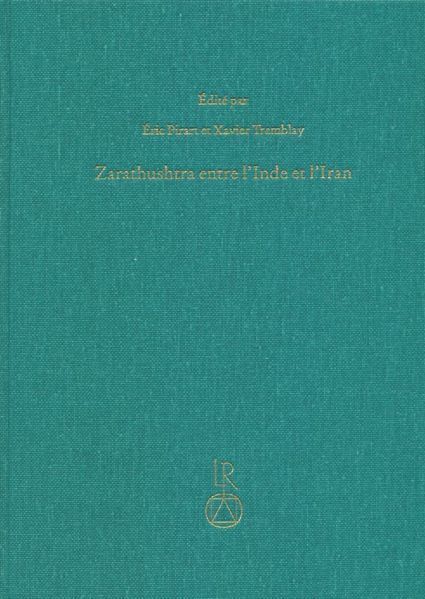
| Reihe | Beiträge zur Iranistik |
|---|---|
| Themen | Sprache und Sprachwissenschaft Sprachwissenschaft, Linguistik |
| ISBN | 9783895006517 |
| Sprache | Französisch |
| Erscheinungsdatum | 09.02.2009 |
| Größe | 24 x 17 cm |
| Verlag | Reichert, L |
| Herausgegeben von | Xavier Tremblay, Eric Pirart |
| Lieferzeit | Lieferung in 7-14 Werktagen |
| Herstellerangaben | Anzeigen Dr. Ludwig Reichert Verlag Inhaberin Ursula Reichert Tauernstraße 11 | DE-65199 Wiesbaden info@reichert-verlag.de |
Uniting the ingenuities of 27 leading indo-europeanists, indologists and iranists from 11 countries (Belgium, France, Germany, Italy, Japan, Netherlands, Poland, Spain, Sweden, United Kingdom, and United States) to celebrate Avestan studies through their acknowledged master Jean Kellens, Professor at the Collège de France (Paris), is already a rare feat, but the present Festschrift was designed to offer still more. The contributors have been chosen in order to illustrate all stages of Jean Kellens’s pathway, first a pupil of Jacques Duchesne-Guillemin in Liège, then of Karl Hoffmann in Erlangen and later of his earliest disciple Helmut Humbach in Mainz at a time (the seventies) when Erlangen was the cauldron whence all innovations in Indo-European studies squirted out, and to discuss the paradigm shifting Jean Kellens introduced in the exegese of the Avesta, the missal and holiest book of the pre-Islamic Paniranian religion, Mazdaeism alias Parsism. The introduction, but also many an article make hints to the dilemmas that have shaped the debate around the oldest Iranian history. Since the very first encounter of European scholarship with the Avestan text the discrepancy between it and the Greek and Western accounts (or merely expectations?) and the very difficulty of the philology stirred up a controversy whether it was a patchwork of fragments sewn together at a late period (say the Sasanid Empire), yielding no sense when put together and whose linguistic value could be appreciated only after a painstaking disentangling and throwing off the disguise of the transmission, or whether it was constituted by large coherent units. Jean Kellens cut the Gordian knot insofar as he sought after formal clues for original composition (reiteration of labelling formulae for instance) and, on the other hand, after ancient joints and commentaries of older pieces, already remixed by the Avestan priests. Thereby he diverted the question from the intention of the (mythical) Primeval Poet towards the purpose, reaffectation and ideology of the texts in a priestly ritual – the selfavowed genre of Avesta itself. Most contributors have taken issue with various aspects of this Kellensian rejuvenation of Avestan studies, which results principally from an explicitation and application to the textology of the methods and results of the “Erlangen silent linguistic revolution”: Alberto Cantera, Gnoli, de Jong, Herrenschmidt, Janda, Lincoln, Oettinger, Panaino, Pirart, Skjærvø and Swennen. Religious history, stylistics and metrics (other favourites of Kellens’s) are illustrated by the articles of Andrés Toledo, Heiner Eichner, Berhard Forssman and Eva Tichy. One must not forget, however, that Jean Kellens has been first known as the best specialist for the Avestan language, and his epoch-making manual „Le Verbe Avestique“ inspired contributions from García-Ramón, Goto, Junko Sakamoto-Goto und Nicholas Sims-Williams, whereas Xavier Tremblay submitted to a new scrutiny, a phonetic law suggested by the jubilary in 1976. The Festschrift for Jean Kellens should also remain as a memorial for the method whichproved so successful in the hands of the Erlangen School of Indo-Europeanists: only a fresh return to the sources, free from any preconceptions, strictly abiding to the grammatical rules, recording step by step every induction and pondering every concurrent possibility, however counterintuitive or bizarre it may seem, will yield ripe crops.
| Reihe | Beiträge zur Iranistik |
|---|---|
| Themen | Sprache und Sprachwissenschaft Sprachwissenschaft, Linguistik |
| ISBN | 9783895006517 |
| Sprache | Französisch |
| Erscheinungsdatum | 09.02.2009 |
| Größe | 24 x 17 cm |
| Verlag | Reichert, L |
| Herausgegeben von | Xavier Tremblay, Eric Pirart |
| Lieferzeit | Lieferung in 7-14 Werktagen |
| Herstellerangaben | Anzeigen Dr. Ludwig Reichert Verlag Inhaberin Ursula Reichert Tauernstraße 11 | DE-65199 Wiesbaden info@reichert-verlag.de |
Wie gefällt Ihnen unser Shop?