GUTSCHEIN
Bitte haben Sie einen Moment Geduld, wir legen Ihr Produkt in den Warenkorb.
Diese Produkte könnten Sie auch interessieren:
Bitte haben Sie einen Moment Geduld, wir legen Ihr Produkt in den Warenkorb.
| Reihe | Dissertationen aus dem Julius Kühn-Institut |
|---|---|
| Themen | Mathematik und Naturwissenschaften |
| ISBN | 9783955471156 |
| Sprache | Englisch |
| Erscheinungsdatum | 03.08.2022 |
| Größe | 21 x 14 cm |
| Verlag | Bundesforschungsinstitut für Kulturpflanzen (JKI) |
| Lieferzeit | Lieferung in 7-14 Werktagen |
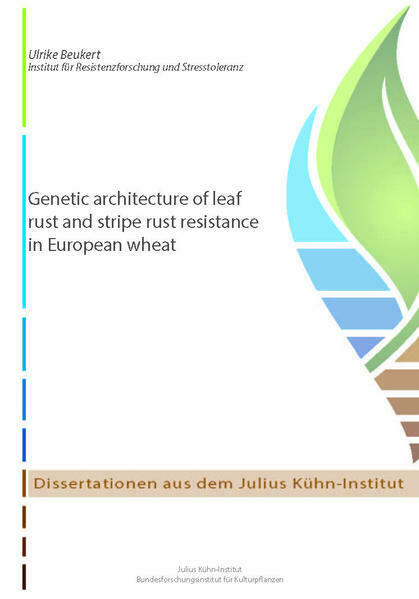
Leaf rust caused by Puccinia triticina and stripe rust caused by Puccinia striiformis f. sp. tritici are highly important fungal wheat diseases limiting the global wheat production. Due to the continuous appearance of new virulent rust races, resistance breeding is aiming to create varieties of durable resistance by accumulating several effective resistance genes. Thus, innovative methods and the combination of promising tools are highly demanded to identify new resistances efficiently as well as to exploit these via improved breeding schemes. For this reason, hybrid breeding, selection based on genotypic information, and automated phenotyping platforms seem to be valuable to improve resistance breeding. In this thesis, the genetic architecture of leaf rust and stripe rust resistance within European wheat was examined and the benefit of using innovative tools to improve the level of rust resistance was assessed. Findings confirmed the higher resistance level of hybrid wheat compared to the parental inbred lines resulting in strong amounts of better-parent heterosis. Many loci associated to resistance showed a desired dominance degree allowing the rapid accumulation of resistance genes by simply fixing them in one parental pool. Therefore, hybrid breeding is a beneficial method to increase leaf rust resistance within European wheat. Performing marker-assisted selection (MAS) is more precise to predict leaf rust resistance than genomic selection (GS). Hence, MAS is suggested as an efficient method supporting leaf rust resistance in European wheat hybrids. In contrast, findings for stripe rust resistance were very inconsistent recommending the examination of genetic architecture in more detail by applying an adjusted methodology. In addition, our results confirmed the examination of detached leaf assays of juvenile plants inoculated under controlled conditions and phenotyped by a robotic- and computer-based high-throughput system as a promising method for precise phenotyping. In summary, the strategies of hybrid breeding, genome-based selection, and modern greenhouse phenotyping are promising to support resistance breeding, to conduct time saving and efficient breeding for rust resistance. The successful introduction of many innovative tools is highly promoting breeding aiming to generate multi-disease resistant varieties, while rapidly increasing the breeding efficiency.
| Reihe | Dissertationen aus dem Julius Kühn-Institut |
|---|---|
| Themen | Mathematik und Naturwissenschaften |
| ISBN | 9783955471156 |
| Sprache | Englisch |
| Erscheinungsdatum | 03.08.2022 |
| Größe | 21 x 14 cm |
| Verlag | Bundesforschungsinstitut für Kulturpflanzen (JKI) |
| Lieferzeit | Lieferung in 7-14 Werktagen |
Wie gefällt Ihnen unser Shop?