GUTSCHEIN
Bitte haben Sie einen Moment Geduld, wir legen Ihr Produkt in den Warenkorb.
Diese Produkte könnten Sie auch interessieren:
Bitte haben Sie einen Moment Geduld, wir legen Ihr Produkt in den Warenkorb.
| Reihe | Dissertationen aus dem Julius Kühn-Institut |
|---|---|
| Themen | Mathematik und Naturwissenschaften |
| ISBN | 9783955471187 |
| Sprache | Englisch |
| Erscheinungsdatum | 27.08.2022 |
| Größe | 21 x 14 cm |
| Verlag | Bundesforschungsinstitut für Kulturpflanzen (JKI) |
| Lieferzeit | Lieferung in 7-14 Werktagen |
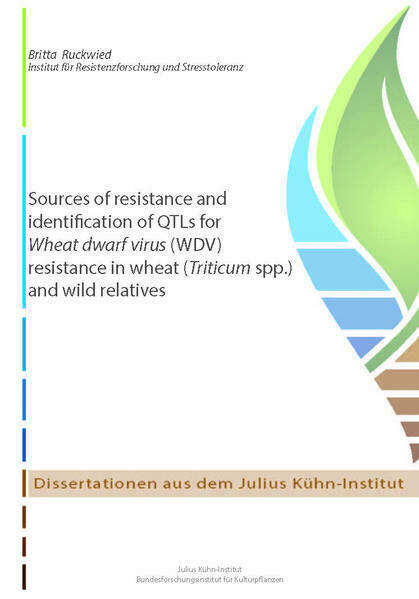
The geminivirus Wheat dwarf virus (WDV) transmitted by the leafhopper Psammotettix alienus causes an economic important disease, especially in winter wheat and barley growing areas. Yield losses caused by insect-transmitted virus diseases are of increasing importance due to global warming. Climate change related higher temperatures in autumn and winter result in prolonged infection periods. One of only few known resistance sources for WDV is the partially resistant Hungarian winter wheat cultivar ‘Mv Vekni’ (Benkovics et al. 2010). To investigate the genetic basis of the partial resistance, two F2 populations comprising 157 plants in sum which derived from a cross between ‘Mv Vekni’ and the susceptible ‘Mv Regiment’ were inoculated by viruliferous leafhoppers in a greenhouse test. A genetic map was constructed based on SNP markers derived from the 15k iSelect Beadchip and QTL mapping was performed. A significant, major QTL was identified for the virus titre on chromosome 6A (QTLVxR- 6A) with the peakmarkers RFL_Contig6053_2072 and Kukri_rep_c95718_868 at LOD = 22.6 explaining 38.4 % of the phenotypic variance with the positive allele derived from ‘Mv Vekni’. In order to identify additional sources of resistance to WDV, 587 di-, tetra- and hexaploid wheat accessions were screened in gauze house inoculation tests using WDV carrying leafhoppers. An association subpanel of 250 hexaploid Triticum accessions was genotyped with the 15k iSelect data to detect MTAs for WDV resistance. The phenotypic screening revealed 19 accessions including T. aestivum, T. vavilovii, T. boeoticum, T. macha, Ae. geniculata, Ae. bicornis and Ae. longissima accessions with a lower average infection rate than ‘Mv Vekni’. In particular, two Triticum vavilovii (TRI 4630, China; TRI 9632, Former Soviet Union) and two Triticum aestivum (PI 245511, Afghanistan; cultivar ‘Fisht’, Russia) showing only 4.4-5.7 % infected plants and 46.2-76.8 % relative yield compared to the uninfected control based on average data from three test years were identified. In the GWAS, 47 significant MTAs (FDR, α < 0.05) representing 35 putative QTLs were detected for relative plant height on chromosomes 1B, 1D, 2B, 3A, 3B, 4A, 4B, 5A, 6A, 7A, 7B (26 QTLs), relative yield on chromosomes 1B, 2B, 3A (7 QTLs) and thousand kernel weight on chromosome 5A (2 QTLs) explaining 7.0-18.3 % of the phenotypic variance. This study revealed that genotypic differences in susceptibility to WDV are present in the wheat genepool across different ploidy levels. The identified QTLs for partial resistance to WDV provide a starting point for the development of molecular markers for marker-assisted WDV resistance breeding.
| Reihe | Dissertationen aus dem Julius Kühn-Institut |
|---|---|
| Themen | Mathematik und Naturwissenschaften |
| ISBN | 9783955471187 |
| Sprache | Englisch |
| Erscheinungsdatum | 27.08.2022 |
| Größe | 21 x 14 cm |
| Verlag | Bundesforschungsinstitut für Kulturpflanzen (JKI) |
| Lieferzeit | Lieferung in 7-14 Werktagen |
Wie gefällt Ihnen unser Shop?