GUTSCHEIN
Bitte haben Sie einen Moment Geduld, wir legen Ihr Produkt in den Warenkorb.
Diese Produkte könnten Sie auch interessieren:
Bitte haben Sie einen Moment Geduld, wir legen Ihr Produkt in den Warenkorb.
| Themen | Mathematik und Naturwissenschaften |
|---|---|
| ISBN | 9783955471682 |
| Sprache | Englisch |
| Erscheinungsdatum | 05.06.2026 |
| Größe | 21 x 14 cm |
| Verlag | Bundesforschungsinstitut für Kulturpflanzen (JKI) |
| Lieferzeit | Lieferung in 7-14 Werktagen |
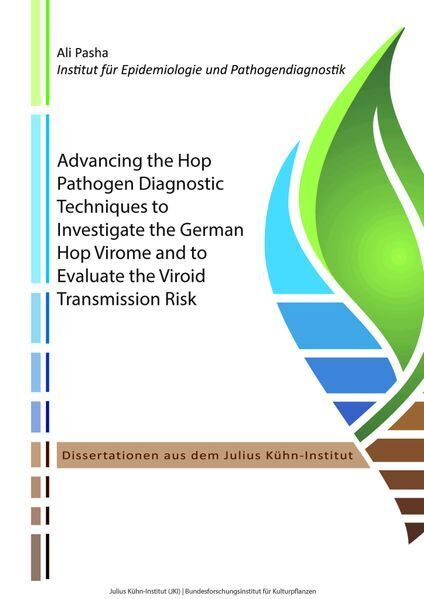
The aim of this research was to optimize and apply advanced diagnostic tools to investigate the diversity, the distribution and the transmission of viruses and viroids infecting the German hops, with particular focus on the newly emerged and severe hop pathogen, citrus bark cracking viroid (CBCVd). In the first part of this dissertation, high-throughput sequencing (HTS) was applied to detect known and unknown viruses and viroids in the German hopyards. We targeted the main hop-growing locations in Germany, namely Hallertau, Elbe-Saale, and Tettnang. A consistent sampling strategy was used across all targeted hopyards, with random collections from hop and non-hop plants growing inside and outside the hopyards. The implementation of HTS in this study enabled the identification of the viral and viroid sequences, and also other plant-associated microorganisms. The identified viral and viroid sequences were confirmed using reverse transcription PCR (RT-PCR). A relatively small number of viruses and viroids were detected in the hop samples. This confirmed the findings of a previous 1980s study that used an available diagnostic method of the time: enzyme-linked immunosorbent assay (ELISA). Although HTS provided valuable insights into the hop virome, the large amount of data it generated required high computational power and bioinformatics expertise, which posed challenges to its practical use. Therefore, the second part of this dissertation aimed to streamline the HTS data analysis process. Therefore, electronic probes (e-probes) were designed, curated, and validated for the direct detection of the most prevalent viruses and viroids in the German hopyard in raw HTS data. This approach offers a user-friendly, efficient solution for plant health agencies and surveillance programs, enabling the application of HTS in pathogen detection without the need for advanced bioinformatics expertise. The third part of this dissertation aimed to evaluate the potential risk of viroid transmission through citrus essential oils (CEOs), recently used in sustainable plant protection products. We proved that CEOs has no impact on RNA extraction or real-time RT-PCR reaction. We also tested the stability of viroid RNAs, and found that they could be detected in CEOs samples stored at room temperature for several weeks, however, an infection of test plants could not be induced by these samples. An infectivity test of alternative hosts showed that spiked CEOs samples were unlikely to infect the plant, whereas viroid RNA without CEOs remained infectious. This suggests that the applications of CEOs pose a minimal risk of viroid transmission. In conclusion, this research applied innovative diagnostic tools for virus and viroid detection, namely HTS, e-probes, real-time RT-PCR and RT-PCR. The application of these tools helped to: investigate the virome diversity in German hops, identify alternative host plants for hop pathogens, simplify the detection of hop pathogens in raw HTS data, and evaluate the potential risks of using CEOs in sustainable plant protection products. Ultimately, the results of this research offer practical solutions for improving plant health diagnostics and provide essential insights into hop pathogen surveillance.
| Themen | Mathematik und Naturwissenschaften |
|---|---|
| ISBN | 9783955471682 |
| Sprache | Englisch |
| Erscheinungsdatum | 05.06.2026 |
| Größe | 21 x 14 cm |
| Verlag | Bundesforschungsinstitut für Kulturpflanzen (JKI) |
| Lieferzeit | Lieferung in 7-14 Werktagen |
Wie gefällt Ihnen unser Shop?