GUTSCHEIN
Bitte haben Sie einen Moment Geduld, wir legen Ihr Produkt in den Warenkorb.
Diese Produkte könnten Sie auch interessieren:
Bitte haben Sie einen Moment Geduld, wir legen Ihr Produkt in den Warenkorb.
| Reihe | FAU Studien aus der Elektrotechnik |
|---|---|
| Themen | Technologie, Ingenieurswissenschaft, Landwirtschaft, Industrieprozesse |
| ISBN | 9783961470723 |
| Sprache | Englisch |
| Erscheinungsdatum | 20.12.2017 |
| Größe | 24 x 17 cm |
| Verlag | FAU University Press |
| Lieferzeit | Lieferung in 7-14 Werktagen |
| Herstellerangaben | Anzeigen FAU University Press university-press@fau.de |
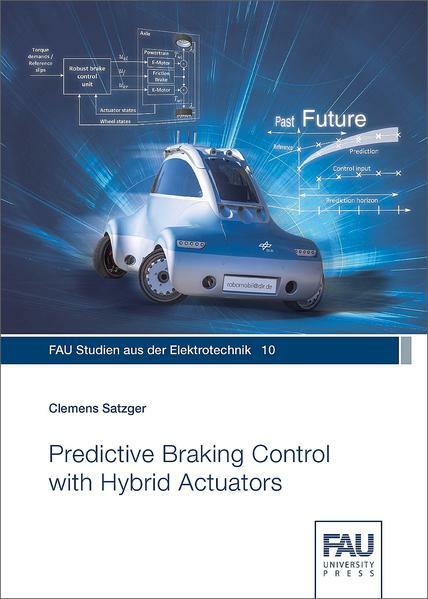
Besides the environmental benefits, electric powertrains offer the potential to improve braking performance by exploiting the fast response of the electric motor. A particularly challenging control task for such systems is braking at the limit of the tire adhesion, which must optimally handle the actuation redundancy of the hybrid braking system in addition to coping with the high system uncertainties and the time varying dynamics of the tire-road contact. The proposed and experimentally validated control framework seeks to optimize the tradeoff between maximizing energy recuperation and optimizing braking dynamics, in the form of wheel torque tracking during normal braking and wheel slip tracking when braking at the limit of the tire adhesion. Conventional solutions such as daisy chain and cascaded control structures provide only suboptimal results due to under-utilization of the actuation dynamics. Therefore, this work proposes a centralized (i.e., ’single-loop’) brake control strategy, where the wheel-slip regulation, torque tracking and torque blending are jointly addressed via the model predictive control framework. Model predictive control is able to account for the effects of system constraints using online optimization, which enables the actuation redundancy of the hybrid brake system to be optimally handled. However, conventional model predictive control approaches for uncertain linear parameter varying systems, such as wheel slip control under time-varying velocity, are either too computationally intensive or do not offer stability guarantees. Spurred by these shortcomings, this work extends existing robust model predictive control design methods to offer feasibility and stability guarantees for linear parameter varying systems with a modest increase in the computational burden. The proposed approach exploits the fact that physical systems represented as linear parameter varying systems usually have a limited rate of change of the scheduling parameter. Consequently, a robust model predictive control formulation is developed that incorporates those parameter rate constraints and constraint tightening methods to reduce its conservatism. The proposed method provides robust stability guarantees for linear parameter varying systems. Finally, its application to the hybrid braking control at the tire-road friction limits concludes this work.
| Reihe | FAU Studien aus der Elektrotechnik |
|---|---|
| Themen | Technologie, Ingenieurswissenschaft, Landwirtschaft, Industrieprozesse |
| ISBN | 9783961470723 |
| Sprache | Englisch |
| Erscheinungsdatum | 20.12.2017 |
| Größe | 24 x 17 cm |
| Verlag | FAU University Press |
| Lieferzeit | Lieferung in 7-14 Werktagen |
| Herstellerangaben | Anzeigen FAU University Press university-press@fau.de |
Wie gefällt Ihnen unser Shop?