Bitte haben Sie einen Moment Geduld, wir legen Ihr Produkt in den Warenkorb.
Diese Produkte könnten Sie auch interessieren:
Bitte haben Sie einen Moment Geduld, wir legen Ihr Produkt in den Warenkorb.
| ISBN | 9783967292657 |
|---|---|
| Erscheinungsdatum | 01.11.2024 |
| Genre | Medizin/Veterinärmedizin |
| Verlag | Mensch & Buch |
| Herausgegeben von | Fachbereich Veterinärmedizin der Freien Universität Berlin |
| Lieferzeit | Lieferung in 7-14 Werktagen |
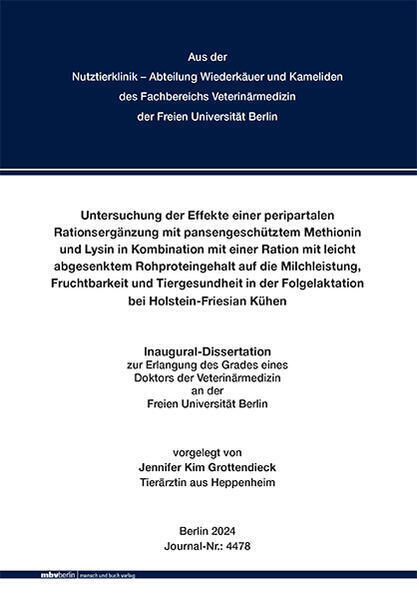
"Investigation of the effects of peripartum supplementation of rumen-protected methionine and lysine in a ration with a slightly reduced crude protein content on milk yield, fertility and animal health during subsequent lactation among Holstein-Friesian cows"
Adjusting the amount of crude protein in feed rations to cover requirements is an effective way for farmers to comply with emission control regulations and can also help to improve animal health, reduce feed costs and improve the economic efficiency. The simultaneous addition of essential rumen-protected amino acids is intended to compensate for the resulting nutrient deficit. If this nutritional adjustment is made in the peripartum period, it can have extensive effects on the health and performance in the subsequent lactation.
The aim of this study was to investigate the effects of a slightly postpartum crude Protein reduction with simultaneous peripartum supplementation of the rumen-protected amino acids methionine and lysine on milk yield, fertility and animal health during the first trimester of lactation. From June 2018 to January 2019 a total of 72 multiparous Holstein-Friesian cows from a conventional dairy farm in north-eastern Germany were selected for a comparative feeding study. The study period lasted from 24 days a.p. to 105 DIM. During this period the cows were divided into two groups (amino acid group AAG, comparison group CG). Ante partum both groups received a ration with common crude protein contents. In addition, a micromineral feed was fed, which was supplemented exclusively in the AAG with rumenprotected methionine and lysine (22,5 g MetaSmart and 20 g LysiGEM per cow per day). Post partum, the crude protein supply in the AAG was slightly reduced (150 g instead of 161 g XP/kg DM and 153 g instead of 157 g nXP/kg DM). At the same time, the amount of rumen-protected AA in the micromineral feed was doubled (45 g MetaSmart and 40 g LysiGEM per cow per day). To enable this differentiated feeding, transponder-supported feeding weighing troughs were used, which enabled individualised access to the group-specific feed. The milk yield was recorded daily during the study period. Milk ingredients (fat, protein, lactose, somatic cell count, urea concentration, nitrogen excretion) were analyzed weekly. To assess fertility, the fertility indicators and the number of semen portions required for pregnancy were evaluated. Pregnancy was determined using blood analyses (P4 on day 19 and PAG between day 31 and 33 after first insemination). Calving, birth weight of the calves and quality of the colostrum were also documented. The examination of postpartum animal health included the documentation of typical diseases (mastitis, metabolic disorders, lameness, abomasal displacement). At six points in time (7 days a.p., 1-3, 14, 21, 35 and 63 days p.p.) blood samples were analysed for relevant prameters and ultrasonographic assessments of condition were carried out. A Urine sample was also taken ante partum. The animal-specific daily dry matter intake was recorded for the entire study period.
Compared to the CG the AAG showed a significantly lower milk yield during the study period (p = 0,046). In addition, lower daily milk protein levels (p = 0,061) and higher milk fat Content (p = 0.069) tended to be observed. In contrast, milk urea concentrations and milk Nitrogen excretion were significantly lower in the AAG than in the CG (p < 0,001). Furthermore, the probability of mastitis was 5 times lower in the AAG (p = 0,019). The results of blood Analysis showed a significant reduction in GLDH and AST activity in the AAG (p < 0,001 and p = 0,003) and thus a reduction in liver metabolism. In addition, the BUN concentration in this group was significantly lower than in the CG (p = 0,001). The other parameters analysed showed no statistically significant differences between the two groups.
In conclusion, it can be stated that the differentiated feeding in this study had a negative effect on milk yield. The fertility was not affected by feeding, while some aspects of animal Health changed for the better.
| ISBN | 9783967292657 |
|---|---|
| Erscheinungsdatum | 01.11.2024 |
| Genre | Medizin/Veterinärmedizin |
| Verlag | Mensch & Buch |
| Herausgegeben von | Fachbereich Veterinärmedizin der Freien Universität Berlin |
| Lieferzeit | Lieferung in 7-14 Werktagen |
Wie gefällt Ihnen unser Shop?