Bitte haben Sie einen Moment Geduld, wir legen Ihr Produkt in den Warenkorb.
Diese Produkte könnten Sie auch interessieren:
Bitte haben Sie einen Moment Geduld, wir legen Ihr Produkt in den Warenkorb.
| Reihe | ABEV Aachener Beiträge zur Energieversorgung |
|---|---|
| ISBN | 9783982635453 |
| Sprache | Englisch |
| Erscheinungsdatum | 01.04.2025 |
| Genre | Technik/Wärmetechnik, Energietechnik, Kraftwerktechnik |
| Verlag | printproduction M. Wolff |
| Herausgegeben von | Albert Univ.-Prof. Dr.-Ing. Moser |
| Lieferzeit | Lieferung in 7-14 Werktagen |
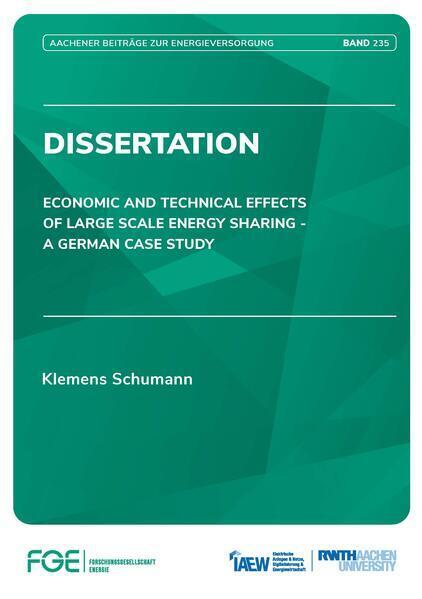
Energy Sharing (ES) has been implemented within the framework of the Clean Energy Package to support the energy transition. The concept enables end customers to exchange self-generated electricity within specific regional boundaries. Germany intends to introduce ES but still needs to define the precise regulatory design. While ES does not lead to significant effects on a small scale, a successful nationwide roll-out of ES could lead to significant economic and technical effects on stakeholders in the energy system. Against this background, the work aims to determine the technical and economic effects of a large-scale roll-out of ES in Germany.
To assess the nationwide impact of ES, a methodological framework is developed that identifies representative Decentralized Energy Systems (DESs) for the entirety of Germany and models each representative DES for a future scenario. The methodology subsequently utilizes a deterministic model to simulate ES within each representative DES, considering each end customer's
flexibility operation, energy marketing, and various regulatory design options. Furthermore, the methodology incorporates simulations of the electric power flow within the distribution grid. By extrapolating effects from each DES to the national level, insights can be derived regarding the large-scale implementation of ES.
The developed method is applied to a scenario representing the year 2037 in Germany. While ES has potential benefits such as enhancing end customers'contribution margin and self-sufficiency, the economic benefit primarily results from a monetary redistribution within the energy system. Future benefits to end customers from ES do not necessitate active subsidy tariffs. The regional scope presents trade-offs between added value for end customers and increased distribution grid utilization. Allowing ES exclusively within the same Low Voltage (LV) or Medium Voltage (MV) grid, while prohibiting inter-grid sharing between LV and MV grids, yields the most favorable trade-off. Dynamic electricity tariffs present greater financial advantages for end customers than ES; however, they adversely affect self-sufficiency and distribution grid utilization. The novel concept of ES can therefore set dynamic price incentives for end customers in the future without having too much of a negative impact on the utilization of
the electrical grid.
| Reihe | ABEV Aachener Beiträge zur Energieversorgung |
|---|---|
| ISBN | 9783982635453 |
| Sprache | Englisch |
| Erscheinungsdatum | 01.04.2025 |
| Genre | Technik/Wärmetechnik, Energietechnik, Kraftwerktechnik |
| Verlag | printproduction M. Wolff |
| Herausgegeben von | Albert Univ.-Prof. Dr.-Ing. Moser |
| Lieferzeit | Lieferung in 7-14 Werktagen |
Wie gefällt Ihnen unser Shop?