GUTSCHEIN
Bitte haben Sie einen Moment Geduld, wir legen Ihr Produkt in den Warenkorb.
Diese Produkte könnten Sie auch interessieren:
Bitte haben Sie einen Moment Geduld, wir legen Ihr Produkt in den Warenkorb.
| Reihe | A Michael Hylton Har Tziyon AS |
|---|---|
| ISBN | 9788294256761 |
| Sprache | Englisch |
| Erscheinungsdatum | 02.09.2026 |
| Größe | 229 x 152 mm |
| Verlag | Independently published |
| Lieferzeit | Lieferung in 7-14 Werktagen |
| Herstellerangaben | Anzeigen Libri GmbH Europaallee 1 | D-36244 Bad Hersfeld gpsr@libri.de |
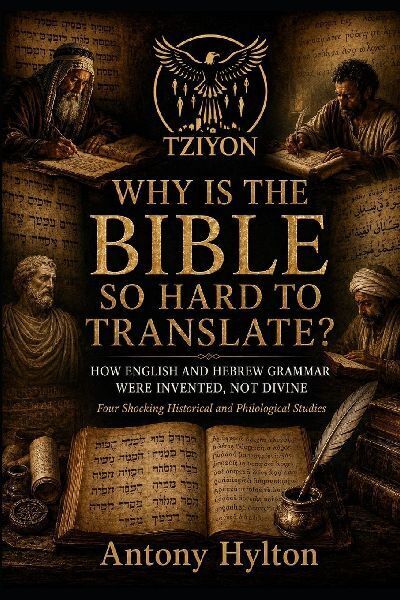
Why is the Bible so hard to translate?Because translating Scripture is never simply a matter of replacing Hebrew or Greek words with English ones.Every translation depends on grammar, pronunciation, vocabulary, textual traditions, and interpretive assumptions. But what if some of the grammatical categories we treat as timeless were actually created by scholars centuries after the biblical texts themselves were written?Why Is the Bible So Hard to Translate? uncovers the remarkable human history behind the grammatical systems used to interpret Scripture.In four provocative historical and philological studies, Antony Hylton traces how English grammar developed from Greek and Latin philosophy, while Hebrew grammar emerged through Jewish scholarship profoundly influenced by Arabic linguistic science. The book shows that a language possesses grammar naturally-but the systems scholars construct to describe that language are historical inventions.Discover: - why the familiar eight parts of speech are not universal laws of language;- how Plato, Aristotle, Dionysius Thrax, Donatus, and later English grammarians shaped the categories still taught today;- how the Masoretes preserved the pronunciation and vocalization of the Hebrew Bible;- how Arabic grammar helped revolutionize the study of Biblical Hebrew;- why Judah Hayyuj's discovery of the three-letter Hebrew root transformed biblical interpretation;- how Jonah Ibn Janah became one of the great pioneers of Hebrew grammar, lexicography, and comparative Semitic philology;- why Hebrew, Aramaic, Arabic, and other cognate languages can illuminate difficult biblical words;- and how the Apostle Paul used Greek Scripture alongside Hebrew and Aramaic language traditions, translation, transliteration, and interpretation.The studies move from ancient Greece to medieval Jewish Spain, from the Masoretes to comparative Semitic philology, and finally to the complex world of Paul and the Greek Scriptures.At the heart of the book lies a challenging distinction: the biblical languages are ancient, but our grammatical systems for describing them are not. Biblical Hebrew existed long before anyone produced a systematic Hebrew grammar.The volume is also designed for readers and audiobook listeners. Hebrew, Aramaic, Arabic, and Greek are presented in readable Latin-character transliteration in the main text, with the original scripts preserved in a consolidated appendix.For readers interested in Biblical Hebrew, Bible translation, the Septuagint, textual criticism, Hebrew grammar, Jewish studies, comparative Semitic linguistics, and Pauline studies, this book reveals just how much history stands between the biblical text and the English Bible in your hands.
| Reihe | A Michael Hylton Har Tziyon AS |
|---|---|
| ISBN | 9788294256761 |
| Sprache | Englisch |
| Erscheinungsdatum | 02.09.2026 |
| Größe | 229 x 152 mm |
| Verlag | Independently published |
| Lieferzeit | Lieferung in 7-14 Werktagen |
| Herstellerangaben | Anzeigen Libri GmbH Europaallee 1 | D-36244 Bad Hersfeld gpsr@libri.de |
Wie gefällt Ihnen unser Shop?