GUTSCHEIN
Bitte haben Sie einen Moment Geduld, wir legen Ihr Produkt in den Warenkorb.
Diese Produkte könnten Sie auch interessieren:
Bitte haben Sie einen Moment Geduld, wir legen Ihr Produkt in den Warenkorb.
| Themen | Mathematik und Naturwissenschaften Naturwissenschaften, allgemein Wissenschaftsphilosophie und -theorie |
|---|---|
| ISBN | 9789027716996 |
| Sprache | Englisch |
| Erscheinungsdatum | 28.02.1985 |
| Verlag | Springer |
| Übersetzung | David A Sipfle, Mary-Alice Sipfle |
| Lieferzeit | Lieferung innerhalb von 28 Werktagen |
| Herstellerangaben | Anzeigen Libri GmbH Europaallee 1 | D-36244 Bad Hersfeld gpsr@libri.de |
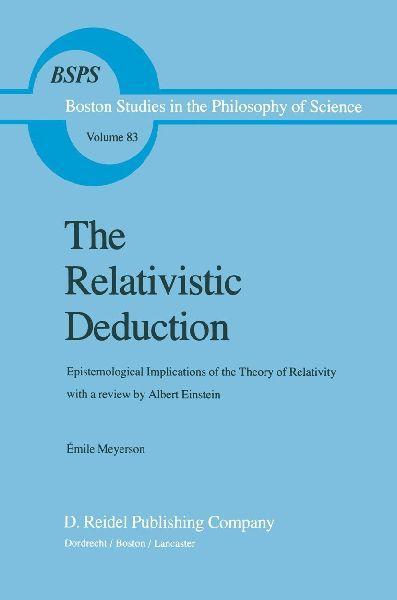
When the author of Identity and Reality accepted Langevin's suggestion that Meyerson "identify the thought processes" of Einstein's relativity theory, he turned from his assured perspective as historian of the sciences to the risky bias of contemporary philosophical critic. But Emile Meyerson, the epis temologist as historian, could not find a more rigorous test of his conclusions from historical learning than the interpretation of Einstein's work, unless perhaps he were to turn from the classical revolution of Einstein's relativity to the non-classical quantum theory. Meyerson captures our sympathy in all his writings: " . . . the role of the epistemologist is . . . in following the development of science" (250); the study of the evolution of reason leads us to see that "man does not experience himself reasoning . . . which is carried on unconsciously," and as the summation of his empirical studies of the works and practices of scientists, "reason . . . behaves in an altogether predict able way: . . . first by making the consequent equivalent to the antecedent, and then by actually denying all diversity in space" (202). If logic - and to Meyerson the epistemologist is logician - is to understand reason, then "logic proceeds a posteriori. " And so we are faced with an empirically based Par menides, and, as we shall see, with an ineliminable 'irrational' within science. Meyerson's story, written in 1924, is still exciting, 60 years later.
| Themen | Mathematik und Naturwissenschaften Naturwissenschaften, allgemein Wissenschaftsphilosophie und -theorie |
|---|---|
| ISBN | 9789027716996 |
| Sprache | Englisch |
| Erscheinungsdatum | 28.02.1985 |
| Verlag | Springer |
| Übersetzung | David A Sipfle, Mary-Alice Sipfle |
| Lieferzeit | Lieferung innerhalb von 28 Werktagen |
| Herstellerangaben | Anzeigen Libri GmbH Europaallee 1 | D-36244 Bad Hersfeld gpsr@libri.de |
Wie gefällt Ihnen unser Shop?