Bitte haben Sie einen Moment Geduld, wir legen Ihr Produkt in den Warenkorb.
Diese Produkte könnten Sie auch interessieren:
Bitte haben Sie einen Moment Geduld, wir legen Ihr Produkt in den Warenkorb.
| Reihe | SpringerBriefs in Computer Science |
|---|---|
| ISBN | 9789811927454 |
| Sprache | Englisch |
| Erscheinungsdatum | 28.05.2022 |
| Genre | Physik, Astronomie/Astronomie |
| Verlag | Springer Singapore |
| Lieferzeit | Lieferbar in 6 Werktagen |
| Herstellerangaben | Anzeigen Springer Nature Customer Service Center GmbH Europaplatz 3 | DE-69115 Heidelberg ProductSafety@springernature.com |
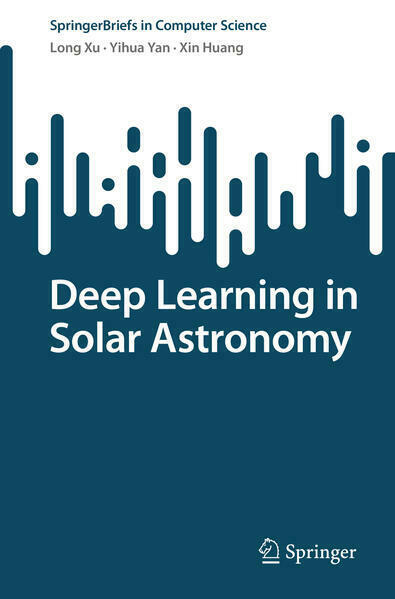
The volume of data being collected in solar astronomy has exponentially increased over the past decade and we will be entering the age of petabyte solar data. Deep learning has been an invaluable tool exploited to efficiently extract key information from the massive solar observation data, to solve the tasks of data archiving/classification, object detection and recognition.
Astronomical study starts with imaging from recorded raw data, followed by image processing, such as image reconstruction, inpainting and generation, to enhance imaging quality. We study deep learning for solar image processing. First, image deconvolution is investigated for synthesis aperture imaging. Second, image inpainting is explored to repair over-saturated solar image due to light intensity beyond threshold of optical lens. Third, image translation among UV/EUV observation of the chromosphere/corona, Ha observation of the chromosphere and magnetogram of the photosphere is realized by using GAN, exhibiting powerful image domain transfer ability among multiple wavebands and different observation devices. It can compensate the lack of observation time or waveband. In addition, time series model, e.g., LSTM, is exploited to forecast solar burst and solar activity indices.
This book presents a comprehensive overview of the deep learning applications in solar astronomy. It is suitable for the students and young researchers who are major in astronomy and computer science, especially interdisciplinary research of them.
| Reihe | SpringerBriefs in Computer Science |
|---|---|
| ISBN | 9789811927454 |
| Sprache | Englisch |
| Erscheinungsdatum | 28.05.2022 |
| Genre | Physik, Astronomie/Astronomie |
| Verlag | Springer Singapore |
| Lieferzeit | Lieferbar in 6 Werktagen |
| Herstellerangaben | Anzeigen Springer Nature Customer Service Center GmbH Europaplatz 3 | DE-69115 Heidelberg ProductSafety@springernature.com |
Wie gefällt Ihnen unser Shop?