GUTSCHEIN
Bitte haben Sie einen Moment Geduld, wir legen Ihr Produkt in den Warenkorb.
Diese Produkte könnten Sie auch interessieren:
Bitte haben Sie einen Moment Geduld, wir legen Ihr Produkt in den Warenkorb.
| Reihe | Independently published |
|---|---|
| ISBN | 9798172432637 |
| Sprache | Englisch |
| Erscheinungsdatum | 07.09.2026 |
| Größe | 254 x 178 mm |
| Verlag | Independently published |
| Lieferzeit | Lieferung in 7-14 Werktagen |
| Herstellerangaben | Anzeigen Libri GmbH Europaallee 1 | D-36244 Bad Hersfeld gpsr@libri.de |
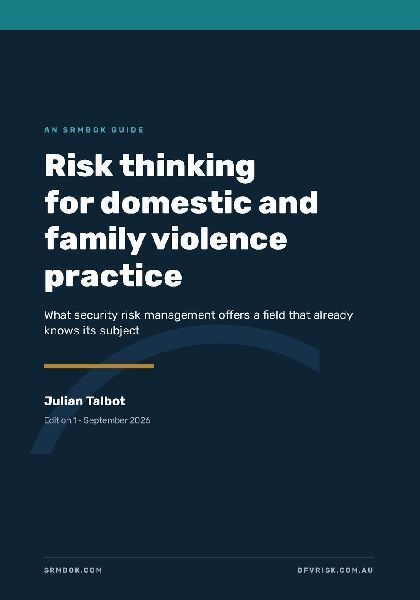
Risk management has spent a century learning how to think about what could go wrong. Almost none of it has reached domestic and family violence practice.This guide brings it across.It is written by a risk practitioner for the specialists who do the work - police, courts, legal practice, health, specialist services, human resources. It assumes you already know the subject. What it offers is the method underneath: a way to describe what you are worried about so that somebody else can act on it.It will not tell you who is dangerous. It does not score a person or a case, and it does not replace the instrument your jurisdiction mandates.What it does: - Separates what a person is capable of from what they are disposed to do - so you can assess how dangerous a situation is without first deciding who is at fault- Explains why family violence is adversarial risk rather than actuarial: every control you apply is information transferred to the person it is applied to, and it will be studied- Aligns domestic and family violence risk management with the Australian Government mandated international standard risk management standard (ISO 31000:2018)- Maps where your error could be sitting, in both directions, and why no rule of the form "believe" or "disbelieve" can avoid both- Grades information on two axes - what you know about the channel, and how well the particular claim holds up - without requiring you to decide who is telling the truth- Shows the difference between a control on paper and a control that works- Gives you CASE, the four Cs and the four As: a risk statement, a finding and a recommendation another professional can act on without ringing youEighteen short chapters, five parts and nine figures. The bow tie. Swiss cheese and causal chains. The hierarchy of controls. The Admiralty grading scheme. Escalation triggers written before they are needed. Documentation that survives a handover, an internal review, an inquest and cross-examination - which all want the same record.Every example is a composite. None is drawn from a real matter, proceeding, person or agency.Chapter 18 is a list of everything this guide cannot do. It may be the most useful chapter in the book.Julian Talbot has worked in risk management for about thirty-five years, across Defence, government, mining, energy and aviation. He is the lead author of the Security Risk Management Body of Knowledge (SRMBOK) and the author of a dozen books on risk, security and decision-making. He is not a domestic and family violence practitioner, and this guide is written on that basis.Edition 1 invites review, and means it.
| Reihe | Independently published |
|---|---|
| ISBN | 9798172432637 |
| Sprache | Englisch |
| Erscheinungsdatum | 07.09.2026 |
| Größe | 254 x 178 mm |
| Verlag | Independently published |
| Lieferzeit | Lieferung in 7-14 Werktagen |
| Herstellerangaben | Anzeigen Libri GmbH Europaallee 1 | D-36244 Bad Hersfeld gpsr@libri.de |
Wie gefällt Ihnen unser Shop?