GUTSCHEIN
Bitte haben Sie einen Moment Geduld, wir legen Ihr Produkt in den Warenkorb.
Diese Produkte könnten Sie auch interessieren:
Bitte haben Sie einen Moment Geduld, wir legen Ihr Produkt in den Warenkorb.
| Reihe | Independently published |
|---|---|
| ISBN | 9798172915642 |
| Sprache | Englisch |
| Erscheinungsdatum | 22.09.2026 |
| Größe | 279 x 216 mm |
| Verlag | Independently published |
| Lieferzeit | Lieferung in 7-14 Werktagen |
| Herstellerangaben | Anzeigen Libri GmbH Europaallee 1 | D-36244 Bad Hersfeld gpsr@libri.de |
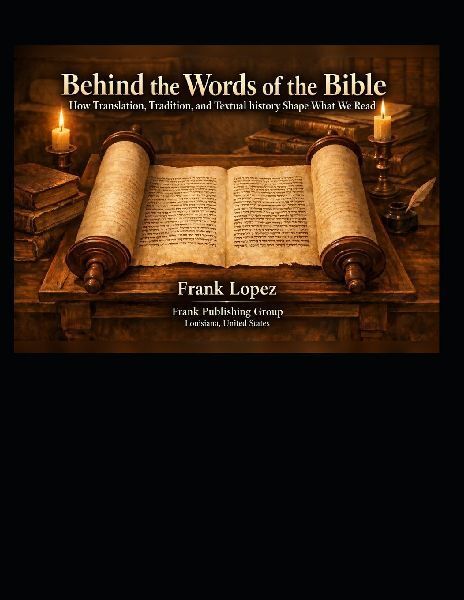
The Bible is one of the most translated, studied, cherished, and debatedcollections of writings in human history. For centuries, its words have shaped religious belief, Behind the Words of the Bible - How Translation, Tradition, and Textual History Shape WhatWe Read moral thought, law, art, literature, and entire civilizations. Yet most readers encounter the Biblenot in ancient Hebrew, Aramaic, or Greek, but through a translation-and every translationinvolves interpretation.This book began with a simple question: What lies behind the familiar words printed in ourmodern Bibles?Terms such as God, Lord, angel, soul, hell, and repentance may appear straightforward inEnglish. However, the ancient words behind them often carried broader, more complexmeanings. A Hebrew or Greek term could express several ideas, while an English translationmay preserve only one. In other cases, traditional rendering has become so familiar that readersno longer realize that another translation is possible.The divine name YHWH, for example, is commonly represented by the title "LORD." TheHebrew word mal'akh means "messenger," although it is frequently translated as "angel." Torahmay mean instruction or teaching, not merely "law." The words nephesh and psychē, traditionally rendered as "soul," do not always refer to an immortal spiritual entity separate fromthe body. Such examples do not necessarily prove that translators acted dishonestly. Theydemonstrate that language, tradition, theology, and history all influence what readers see on theprinted page.Translation is never a mechanical exchange in which one word in an ancient language alwayscorresponds perfectly to one word in another. A translator must consider grammar, context, idiom, literary form, historical setting, and the expectations of the intended audience. When asource word has several meanings, choosing one inevitably places the others in the background.Even capitalization, punctuation, paragraph divisions, and headings can guide readers toward aparticular interpretation, though these features were not always present in the earliestmanuscripts.The biblical text also has a history of transmission. The original manuscripts have not survived.What we possess are handwritten copies, ancient translations, quotations, fragments, and latermanuscript traditions. These witnesses agree to a remarkable degree, but they are not identical inevery detail. Scribes sometimes made mistakes, clarified difficult expressions, harmonizedparallel passages, or added explanatory material. Modern textual criticism compares thesurviving evidence in an effort to identify the earliest recoverable wording.
| Reihe | Independently published |
|---|---|
| ISBN | 9798172915642 |
| Sprache | Englisch |
| Erscheinungsdatum | 22.09.2026 |
| Größe | 279 x 216 mm |
| Verlag | Independently published |
| Lieferzeit | Lieferung in 7-14 Werktagen |
| Herstellerangaben | Anzeigen Libri GmbH Europaallee 1 | D-36244 Bad Hersfeld gpsr@libri.de |
Wie gefällt Ihnen unser Shop?