GUTSCHEIN
Bitte haben Sie einen Moment Geduld, wir legen Ihr Produkt in den Warenkorb.
Diese Produkte könnten Sie auch interessieren:
Bitte haben Sie einen Moment Geduld, wir legen Ihr Produkt in den Warenkorb.
| Reihe | Independently published |
|---|---|
| ISBN | 9798174302051 |
| Sprache | Englisch |
| Erscheinungsdatum | 14.09.2026 |
| Größe | 279 x 216 mm |
| Verlag | Independently published |
| Lieferzeit | Lieferung in 7-14 Werktagen |
| Herstellerangaben | Anzeigen Libri GmbH Europaallee 1 | D-36244 Bad Hersfeld gpsr@libri.de |
For most of human history, people lived much closer to the natural resources that sustained them. Across the inhabited continents, communities created and maintained food forests, managed woodlands, fisheries, pastures, gardens, and other productive landscapes that supplied food and essential materials directly from the places where they lived. These systems were neither primitive nor accidental. Many were deliberately shaped over generations through planting, burning, pruning, irrigation, selective harvesting, and the protection of useful species. Life was still difficult, unequal, and deeply interdependent, but people often had substantial direct access to the resources they needed, without those necessities first having to pass through a government office, employer, landlord, or commercial system.
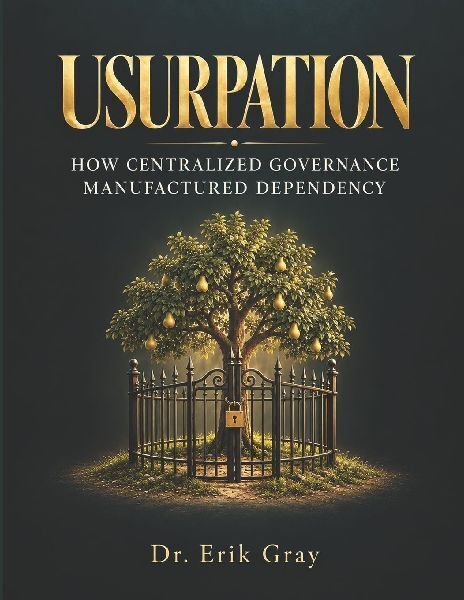
Usurpation examines what happened when that changed. Across different parts of the world, centralized governments claimed authority over land and resources that communities had long used, managed, and depended upon. Forests became state property. Common lands were enclosed. Movement was restricted. Traditional rights were displaced or made conditional through permits, taxes, titles, and administrative rules. In some places, people were relocated, their access to productive landscapes was severed, or they were compelled to enter new systems of labor and production. The result was often more than the loss of land. As older ways of obtaining food, materials, and security became harder or impossible to use, people became increasingly dependent upon wages, markets, public assistance, and the institutions that controlled access to what they needed. What later appeared to demonstrate the necessity of those institutions could therefore reflect the loss of alternatives that had once made greater independence possible. Drawing on cases from Europe, Africa, Asia, the Pacific, the Americas, and the Arctic, Dr. Erik Gray traces how systems of direct provision were narrowed through enclosure, taxation, forced relocation, plantation economies, forest law, conservation, and administrative control. Yet this is not a simple indictment of states, markets, or modernity. Markets could liberate. States could protect. Commons could exclude. Disease, climate, and ecological shock could destroy productive systems without anyone intending to seize them. The argument that survives those complications is both narrower and more powerful: dependency becomes politically consequential when people lose alternatives and have no choice but to pass through a single gate. Usurpation is an inventory of how those gates were built-how varied systems of governance across every continent narrowed direct access to land, food, forests, water, and other natural resources; how that loss of access manufactured dependency; and how communities were then conditioned to regard that dependency as the only viable way to live.| Reihe | Independently published |
|---|---|
| ISBN | 9798174302051 |
| Sprache | Englisch |
| Erscheinungsdatum | 14.09.2026 |
| Größe | 279 x 216 mm |
| Verlag | Independently published |
| Lieferzeit | Lieferung in 7-14 Werktagen |
| Herstellerangaben | Anzeigen Libri GmbH Europaallee 1 | D-36244 Bad Hersfeld gpsr@libri.de |
Wie gefällt Ihnen unser Shop?