GUTSCHEIN
Bitte haben Sie einen Moment Geduld, wir legen Ihr Produkt in den Warenkorb.
Diese Produkte könnten Sie auch interessieren:
Bitte haben Sie einen Moment Geduld, wir legen Ihr Produkt in den Warenkorb.
| Reihe | Independently published |
|---|---|
| ISBN | 9798175183345 |
| Sprache | Englisch |
| Erscheinungsdatum | 17.09.2026 |
| Größe | 229 x 152 mm |
| Verlag | Independently published |
| Lieferzeit | Lieferung in 7-14 Werktagen |
| Herstellerangaben | Anzeigen Libri GmbH Europaallee 1 | D-36244 Bad Hersfeld gpsr@libri.de |
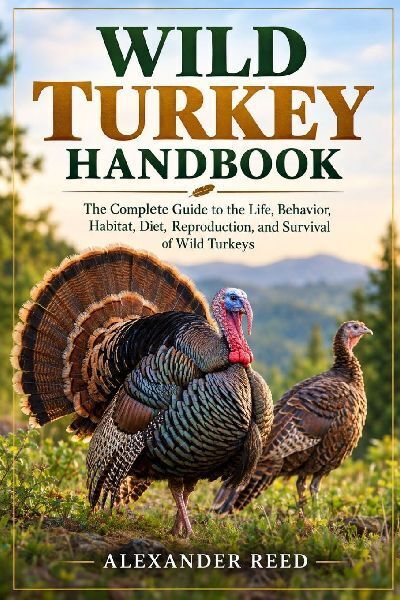
The wild turkey, Meleagris gallopavo, is one of North America's most recognizable native birds and a remarkable example of adaptation, social behavior, and wildlife recovery. Although familiar to many people, the species has a complex life shaped by its physical abilities, seasonal environment, social relationships, and interactions with humans.
Wild turkeys depend on diverse habitats rather than a single environment. Forests provide important roosting and protective areas, while woodland edges, openings, fields, and areas with dense ground vegetation provide food and nesting or brood-rearing opportunities. A landscape containing several habitat types can support turkeys throughout the year. Their physical structure is closely connected to their way of life. Powerful legs allow them to walk and run efficiently, while strong wings give them the ability to fly despite their large bodies. Their excellent eyesight, sensitive hearing, specialized feathers, and strong senses help them detect predators and navigate their surroundings. Males also possess distinctive physical features, including spurs used during competition. Food availability changes throughout the year. Wild turkeys are omnivorous and consume seeds, nuts, fruits, vegetation, insects, and other small food items. They search actively across the forest floor and open ground, adjusting their diet according to seasonal availability. Their feeding behavior demonstrates considerable flexibility and an ability to remember productive locations. Social behavior is equally important. Turkeys commonly form groups and maintain relationships through vocalizations, body language, movement, and visual displays. Their communication system includes gobbles, yelps, clucks, purrs, alarm calls, and other sounds. Social interactions help birds maintain contact, respond to danger, establish dominance, and coordinate group activities. The breeding season brings some of the wild turkey's most recognizable behaviors. Males display by gobbling, strutting, spreading their tails, and changing their posture. Females select suitable nesting locations and later lead their young through the environment. Turkey poults develop quickly, but their early lives remain dangerous because of predators, weather, food shortages, and other environmental pressures.| Reihe | Independently published |
|---|---|
| ISBN | 9798175183345 |
| Sprache | Englisch |
| Erscheinungsdatum | 17.09.2026 |
| Größe | 229 x 152 mm |
| Verlag | Independently published |
| Lieferzeit | Lieferung in 7-14 Werktagen |
| Herstellerangaben | Anzeigen Libri GmbH Europaallee 1 | D-36244 Bad Hersfeld gpsr@libri.de |
Wie gefällt Ihnen unser Shop?