GUTSCHEIN
Bitte haben Sie einen Moment Geduld, wir legen Ihr Produkt in den Warenkorb.
Diese Produkte könnten Sie auch interessieren:
Bitte haben Sie einen Moment Geduld, wir legen Ihr Produkt in den Warenkorb.
| Reihe | Independently published |
|---|---|
| ISBN | 9798175918046 |
| Sprache | Englisch |
| Erscheinungsdatum | 20.09.2026 |
| Größe | 279 x 216 mm |
| Verlag | Independently published |
| Lieferzeit | Lieferung in 7-14 Werktagen |
| Herstellerangaben | Anzeigen Libri GmbH Europaallee 1 | D-36244 Bad Hersfeld gpsr@libri.de |
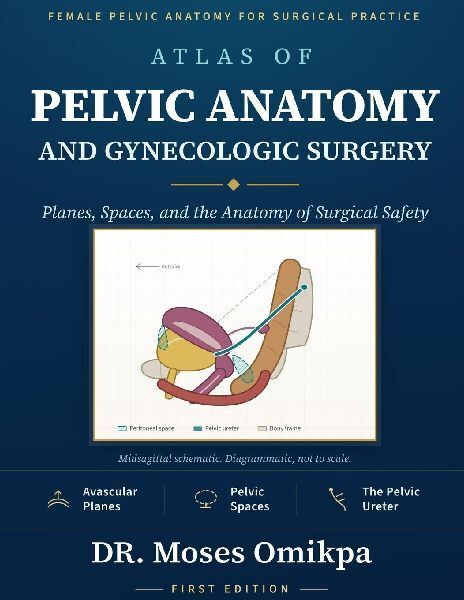
Most gynecologic surgical injury is anatomical in origin, not technical. The ureter. The bladder base. The obturator nerve. The presacral venous plexus. Trainees learn procedures as sequences of steps - then meet a pelvis distorted by endometriosis, fibroids, prior caesarean or malignancy, and have no framework left to fall back on. This book teaches the framework.
WHAT THIS BOOK DOES DIFFERENTLY Most references teach the pelvis as a list of organs. This one teaches it as a set of avascular planes and named retroperitoneal spaces first, and the organs second - because that is the order a surgeon actually needs. It also does something unusual: where the literature disagrees, it says so. - The mean ureter-to-cervix distance is about 2.3 cm. The reported range runs from 0.1 cm to 5.3 cm. This book explains why that means no distance-based rule protects the ureter. - No single internal iliac branching pattern accounts for a majority of patients - and the distribution differs sharply by population. - Net skin-to-great-vessel distance FALLS as body mass rises. The thin patient carries the greater vascular entry risk, not the obese one. - Reported injury rates vary twentyfold - because studies that do not look for injury do not find it. Quantitative figures are given as ranges, with the study population named. Contested structures are presented as contested. You will not find a confident single number standing in for a disputed literature. WHO THIS BOOK IS FOR - OB-GYN residents, all years - Final-year medical students on surgical and OB-GYN rotations - Gynecologic oncology and urogynecology fellows - General, colorectal and urological surgeons operating in the female pelvis - Anatomy demonstrators, OR nurses and surgical assistants WHAT IS INSIDE Six parts. Twenty-eight chapters. Fifty-seven original diagrams, charts and concept figures. I. Orientation - bony pelvis, abdominal wall, fascial architecture II. Vessels, lymphatics and nerves - because every boundary is one or the other III. Spaces, planes and the ureter - the core, with a chapter devoted entirely to the pelvic ureter IV. Organs and the pelvic floor V. Anatomy applied to each surgical approach VI. The pelvis that is not normal - distortion, complication anatomy, congenital variation WHAT THIS BOOK IS NOT It contains no operative technique, no drug or dosing information, and no device guidance. Those omissions are deliberate. This book tells you where structures are and why their arrangement matters. It does not tell you what to do with them - that is what supervised training is for. The figures are diagrams, charts and concept figures. They map topology, data, boundaries and principles. They are not photographic or morphological illustrations. An educational reference for readers with clinical training. Not medical advice, not peer-reviewed, and not a substitute for professional judgement or supervision.| Reihe | Independently published |
|---|---|
| ISBN | 9798175918046 |
| Sprache | Englisch |
| Erscheinungsdatum | 20.09.2026 |
| Größe | 279 x 216 mm |
| Verlag | Independently published |
| Lieferzeit | Lieferung in 7-14 Werktagen |
| Herstellerangaben | Anzeigen Libri GmbH Europaallee 1 | D-36244 Bad Hersfeld gpsr@libri.de |
Wie gefällt Ihnen unser Shop?