GUTSCHEIN
Bitte haben Sie einen Moment Geduld, wir legen Ihr Produkt in den Warenkorb.
Diese Produkte könnten Sie auch interessieren:
Bitte haben Sie einen Moment Geduld, wir legen Ihr Produkt in den Warenkorb.
| Reihe | Independently published |
|---|---|
| ISBN | 9798176119992 |
| Sprache | Englisch |
| Erscheinungsdatum | 21.09.2026 |
| Größe | 229 x 152 mm |
| Verlag | Independently published |
| Lieferzeit | Lieferung in 7-14 Werktagen |
| Herstellerangaben | Anzeigen Libri GmbH Europaallee 1 | D-36244 Bad Hersfeld gpsr@libri.de |
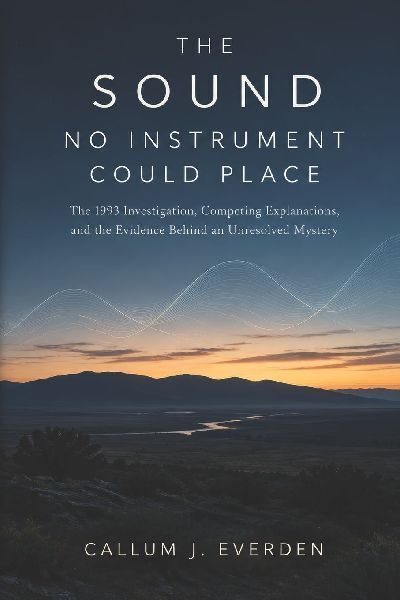
A low-frequency sound was reported across northern New Mexico. The investigation found the experience-but not one agreed source.In the early 1990s, residents in and around Taos began reporting a persistent hum: low, difficult to locate, and audible to only some people. By 1993, the reports had drawn enough attention to produce a multidisciplinary investigation involving acoustic, seismic, magnetic, electrostatic, and electromagnetic measurements. The central question seemed simple: if one external source was producing the Taos Hum, what physical signal should investigators have been able to detect?The Sound No Instrument Could Place reconstructs that investigation from the evidence outward. It follows what hearers reported, how investigators tried to reproduce the perceived sound, and what happened when controlled matching tests placed the reported carrier frequencies roughly between 32 and 80 Hz. It then separates those perceptual matches from the harder question of whether a corresponding environmental signal was actually present.The search moved through machinery, electrical infrastructure, ground vibration, magnetic fields, electromagnetic signals, and the suspected Navy ELF connection. Each explanation is treated as a testable chain rather than a ready-made answer: where would the source have been, how would its energy have reached the hearers, and did the measurements record what that theory required?When the environmental campaign failed to establish one common external source, the investigation turned toward hearing. A regional survey identified a subset of residents who consistently reported the Hum, while later research raised new questions about low-frequency hearing, tinnitus-like perception, inner-ear mechanisms, and the possibility that different hearers could be experiencing different causes under the same public label.The book also examines what later hearing research changes-and what it does not. A 2026 laboratory study tested proposed low-frequency mechanisms in a separate group of hearers, weakening some explanations without retroactively diagnosing the original Taos participants. The distinction matters: later science can narrow possibilities, but it cannot supply measurements that were never taken in 1993.Written as an evidence-aware scientific mystery, this account keeps perception, instrument readings, hypothesis, and inference on separate tracks. It does not treat an unidentified source as proof of concealment, and it does not dismiss a reported experience simply because instruments did not isolate a matching signal.For readers interested in the Taos Hum, unexplained low-frequency sound, acoustic investigation, auditory perception, environmental measurement, and unresolved scientific questions, this book follows the evidence to the point where certainty ends-and shows why the single-source problem remains open.
| Reihe | Independently published |
|---|---|
| ISBN | 9798176119992 |
| Sprache | Englisch |
| Erscheinungsdatum | 21.09.2026 |
| Größe | 229 x 152 mm |
| Verlag | Independently published |
| Lieferzeit | Lieferung in 7-14 Werktagen |
| Herstellerangaben | Anzeigen Libri GmbH Europaallee 1 | D-36244 Bad Hersfeld gpsr@libri.de |
Wie gefällt Ihnen unser Shop?