GUTSCHEIN
Bitte haben Sie einen Moment Geduld, wir legen Ihr Produkt in den Warenkorb.
Diese Produkte könnten Sie auch interessieren:
Bitte haben Sie einen Moment Geduld, wir legen Ihr Produkt in den Warenkorb.
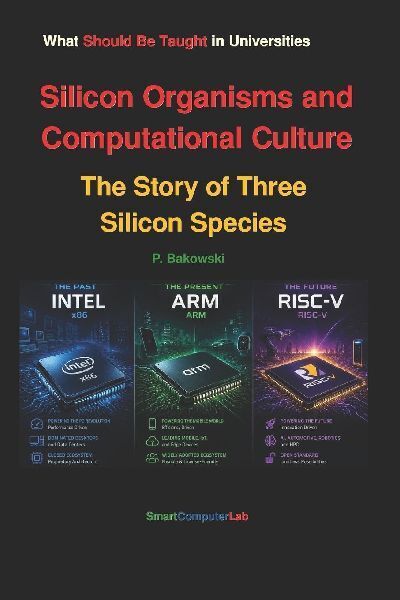
This book presents a novel perspective on the history and future of computing by viewing processor architectures as evolving entities within a technological ecosystem, a "silicon biosphere." Inspired by evolutionary biology, it argues that instruction set architectures (ISAs), hardware description languages, EDA tools, semiconductor technologies, and software ecosystems collectively form an artificial evolutionary system analogous to biological life.
Within this framework, the ISA functions as a digital genome, preserving the identity of a processor family across generations. Hardware description languages such as Verilog serve as mechanisms for expressing architectural information, while EDA tools transform these descriptions into physical silicon implementations. Software ecosystems act as repositories of accumulated knowledge, enabling continuity and adaptation over time. The book explores the similarities between biological and technological evolution. Architectural innovations resemble mutations, market competition acts as natural selection, and successful designs spread through adoption and replication. Using this evolutionary lens, the book examines the development of the three dominant processor architectures of the modern era: x86, ARM, and RISC-V. The x86 architecture is presented as a highly adaptable lineage that has maintained compatibility for decades while continuously evolving its internal design. ARM represents a different evolutionary strategy based on simplicity, energy efficiency, and a licensing model that enabled widespread diversification across mobile and embedded markets. RISC-V introduces a new paradigm: an open instruction set architecture that separates the ISA from its implementation, creating unprecedented opportunities for innovation and experimentation. Special attention is given to the rapid expansion of the global RISC-V ecosystem, including the growing contributions of universities, research institutions, semiconductor companies, and open-source communities. The book highlights how open architectures are reshaping the competitive landscape of computing and enabling new forms of collaborative innovation. The concluding chapters argue that computing is entering a new evolutionary phase characterized by openness, modularity, and globally distributed development. As open-source hardware and open instruction sets gain momentum, the mechanisms driving technological progress increasingly resemble those observed in biological systems. Understanding processor architectures through the lens of evolution provides a powerful framework for interpreting both the history of computing and its future trajectory within an emerging silicon biosphere.Wie gefällt Ihnen unser Shop?