GUTSCHEIN
Bitte haben Sie einen Moment Geduld, wir legen Ihr Produkt in den Warenkorb.
Diese Produkte könnten Sie auch interessieren:
Bitte haben Sie einen Moment Geduld, wir legen Ihr Produkt in den Warenkorb.
| Reihe | The Abolition Classics - Collected Editions |
|---|---|
| Themen | Gesellschaft und Sozialwissenschaften Gesellschaft und Kultur, allgemein Soziale und ethische Themen Ethische Fragen, Themen und Debatten Todesstrafe |
| ISBN | 9798235012387 |
| Sprache | Englisch |
| Erscheinungsdatum | 27.08.2026 |
| Größe | 229 x 152 mm |
| Verlag | Complicit Press |
| Lieferzeit | Lieferung in 7-14 Werktagen |
| Herstellerangaben | Anzeigen Libri GmbH Europaallee 1 | D-36244 Bad Hersfeld gpsr@libri.de |
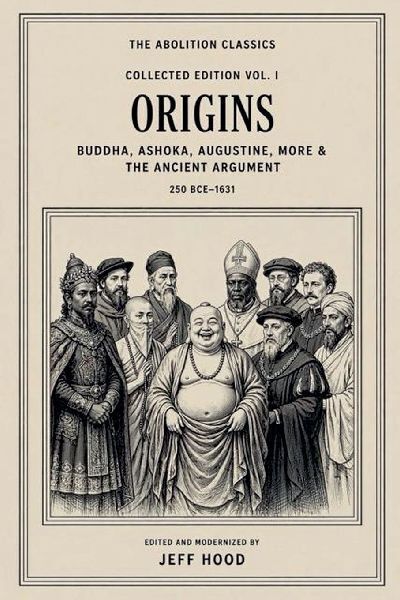
Every state in history has killed people. For most of that history, nobody thought it needed defending.The argument against it is supposed to begin in 1764. That year, an Italian named Cesare Beccaria published a short book saying the state had no right to take a life, and Europe began to listen. Every history of the death penalty starts there.This volume exists because that date leaves out eighteen centuries.Origins gathers the three earliest volumes of The Abolition Classics into one book. The series collects the writing of people who said, in their own centuries, that killing a prisoner is wrong.It opens with the only text in the series spoken by a condemned man. In 399 BCE, an old philosopher stood in an Athenian courtroom before five hundred of his fellow citizens, was sentenced to die, and refused to beg for his life. His name was Socrates.It continues with: Before Abolitionism, numerous witnesses across nineteen centuries. The Jain s¿tras of India, which forbid the killing of anything that breathes. A¿oka, an emperor who slaughtered his way across a subcontinent, repented, and cut into stone that every condemned man be given three days of grace. The Mishnah, the rabbis' code of law, which built a capital trial so demanding that a court executing one man in seven years was called a court of blood. Augustine, a bishop in North Africa, pleading with a judge to spare the men who had murdered his clergy. Pope Nicholas I, writing to the newly Christian Bulgarians: stop the torture, stop the killing. Petr Chel¿ický, a Czech layman who refused the sword. Thomas More, an English chancellor who argued that hanging thieves was useless as well as unjust, and was beheaded himself. Sebastian Castellio, who watched Geneva burn a man for what he believed and said that killing a man does not defend a doctrine. And the Jesuit Friedrich Spee, who heard the confessions of women condemned as witches, walked them to the fire, buried them, and wrote that not one of them was guilty.It closes with Lactantius, writing while the emperor Diocletian was hunting Christians through the empire, and the most absolute sentence in the early church: it is always unlawful to put a man to death.None of these writers knew what the others had said. That is the argument of the book. The objection to killing is not a modern invention.
| Reihe | The Abolition Classics - Collected Editions |
|---|---|
| Themen | Gesellschaft und Sozialwissenschaften Gesellschaft und Kultur, allgemein Soziale und ethische Themen Ethische Fragen, Themen und Debatten Todesstrafe |
| ISBN | 9798235012387 |
| Sprache | Englisch |
| Erscheinungsdatum | 27.08.2026 |
| Größe | 229 x 152 mm |
| Verlag | Complicit Press |
| Lieferzeit | Lieferung in 7-14 Werktagen |
| Herstellerangaben | Anzeigen Libri GmbH Europaallee 1 | D-36244 Bad Hersfeld gpsr@libri.de |
Wie gefällt Ihnen unser Shop?